
Choosing the Right Transformer Size for Landscape Lighting
The Enchanting Artistry of Landscape Lighting
In the realm of exterior design, landscape lighting emerges as an essential component that not only enhances aesthetic appeal but also augments functionality and safety. Just as a virtuoso painter skillfully uses a palette of colors to breathe life into a blank canvas, so strategic landscape lighting transforms the world into magnificent when night falls.
It highlights architectural features, guides pathways, and creates enchanting nocturnal vistas in gardens, patios, and yards. Effectively executed landscape lighting has the ability to infuse ordinary outdoor spaces with an extraordinary radiance that extends beyond visual allure – it fosters a welcoming ambiance for social gatherings and provides vital illumination for secure navigation during twilight hours.
Pioneering Luminescence: The Role of Transformers in Landscape Lighting
Within this intriguing dance of light and shadow lies an unsung hero – the transformer. Transformers for landscape lighting are not merely supporting players but pivotal characters in this unfolding drama of darkness sculpted by light. These unobtrusive devices function as power regulators, modulating electrical currents to ensure that each light fixture receives its requisite supply of voltage without faltering or overwhelming its capacity.
From humble path lights nestling amidst your flower beds to grandiose post lamps flanking your driveway entrance – every element in your illuminated nightscape is empowered by transformers, which quietly orchestrate these symphonies of photons from behind the scenes. Their unseen hand guides the rhythm of luminescence across varied types of fixtures – be it halogen bulbs emitting warm glows or LEDs bestowing cool radiance – and their sizes range accordingly.
Powering Elegance: Why Choosing the Right Transformer Size Matters
The selection process involved while deciding on the perfect transformer size is far from arbitrary – it is intrinsically tied to both form and function within your overall lighting design scheme. The right choice can enhance the aesthetics, ensure longevity, and optimize the efficiency of your landscape lighting system.
Choosing an inadequate transformer size may result in dim lights, compromised longevity, or even complete system failure. On the other hand, a transformer that is too large not only wastes energy but also affects your pocketbook with higher electricity bills.
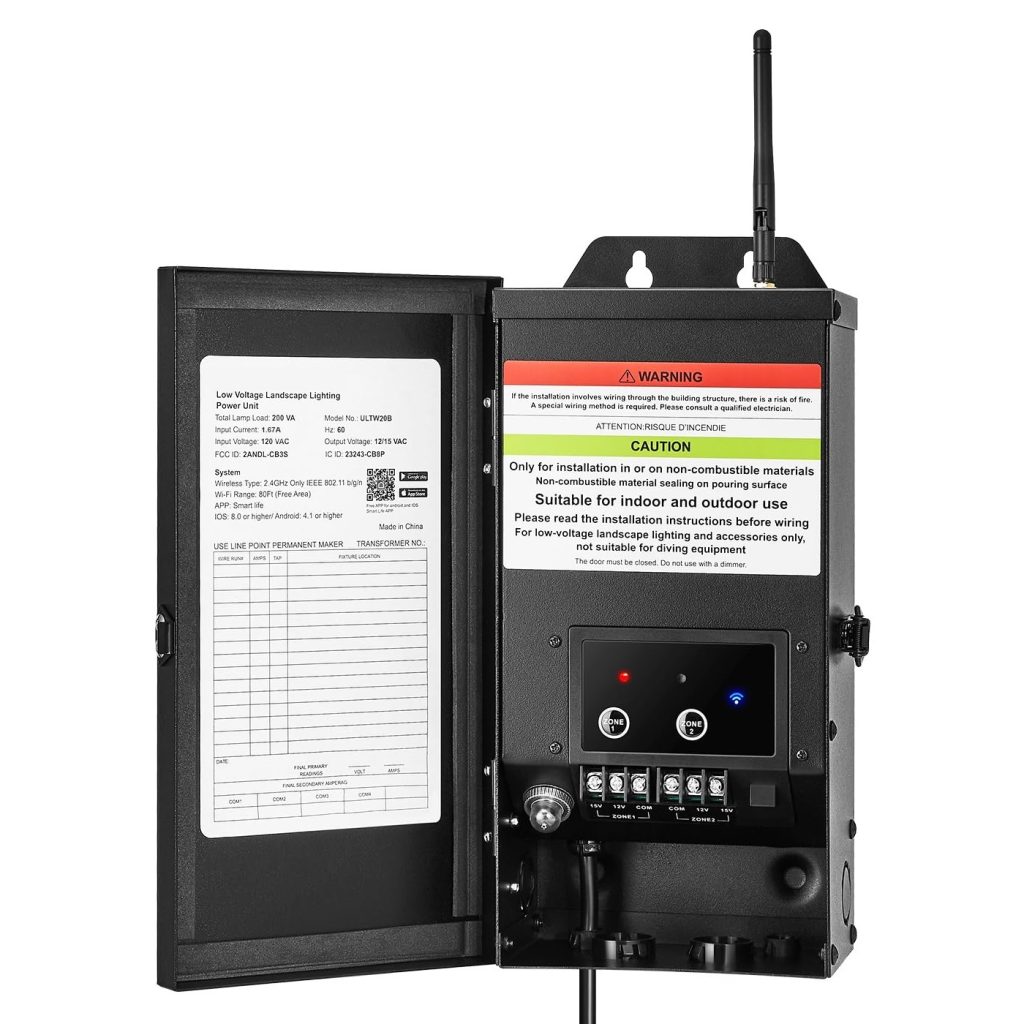
Hence, determining the appropriate size of a transformer for landscape lighting is crucial – it is akin to choosing the heart that supports a living body of artistry shaped by light. With this in mind, this post aims to demystify transformers for landscape lighting and elucidate how one can select an optimal size to suit their specific needs – lighting pathways towards informed decisions that empower radiant vistas each time twilight descends upon your landscaped haven.
Demystifying Transformers: The Unsung Heroes of Landscape Lighting
In its simplest definition, a transformer is an electrical device that transfers electrical energy between two or more circuits through electromagnetic induction. Typically deployed in landscape lighting, these instrumental devices alter the voltage levels to precisely match the lighting requirements. This process provides notable functional and safety benefits. It allows different kinds of lighting fixtures with varying voltage requirements to be used within a single system and significantly reduces the risk of electrical faults or failures.
The Spectrum of Transformers: Tailoring Electricity to Suit Your Needs
Transformers come in a myriad of types, each designed for specific applications and offering varied attributes. For landscape lighting purposes, three types are most commonly employed: step-down transformers, electronic low-voltage (ELV) transformers, and magnetic low-voltage (MLV) transformers.
Step-Down Transformers: Dipping into Lower Voltages
As their name suggests, step-down transformers reduce higher voltages to lower ones. They are generally chosen for installations where the primary voltage source is above what’s safe or optimal for the lighting fixtures. We often find them in use when transitioning from mainline residential or commercial power supplies to delicate landscape light setups.
Electronic Low-Voltage (ELV) Transformers: A Symbiosis between Electronics and Mechanics
ELV transformers leverage electronics to achieve their function effectively while maintaining a compact form factor. They provide excellent regulation under fluctuating loads due to their fast response times and high-frequency operation – making them ideal for advanced lighting systems that require precise control over light intensity.
Magnetic Low-Voltage (MLV) Transformers: Harnessing Magnetism
MLV transformers work on simple principles of magnetism, but don’t be fooled by their simplicity – they are sturdy workhorses perfect for heavy-duty applications with high wattage needs. MLVTs rely on the magnetic field generated between their primary and secondary coils to convert voltage, making them an optimal choice for large-scale outdoor lighting setups where reliability is key.
The Transformer’s Role: An Impressive Performance
When we delve into landscape lighting, transformers play a pivotal role in ensuring optimal performance of the lights. Acting as a bridge between the power source and light fixtures, they adjust the input voltage to match fixture requirements – whether these call for a step-down or step-up in voltage.

In addition to this crucial task of voltage regulation, they also function as gatekeepers, protecting the entire system from potential overloads or short circuits. Thus, understanding transformers and how they operate provides invaluable insights into creating efficient and safe landscape lighting systems.
Factors to Consider when Choosing a Transformer for Landscape Lighting
The Crucial Element: Total Wattage of the Light Fixtures
The first pivotal factor in choosing the right transformer for landscape lighting is the total wattage of the light fixtures. Simply put, it’s the sum of the power ratings of all individual lights that you plan to connect to one transformer. To calculate total wattage, simply add up each fixture’s wattage.
For example, if you’re installing ten 20-watt bulbs on your property, the total wattage will be 200 watts (10 bulbs x 20 watts each = 200 watts). This calculation is fundamental as it helps determine what size transformer you will require.
Let’s consider another case where you have 15 light fixtures, each with a power rating of 12 watts. The total wattage in this case would be 180 watts (15 bulbs x 12 watts each).
A common mistake is purchasing a transformer that exactly matches this total load. Instead, experts recommend getting one that exceeds this by about twenty-five percent to cater to future expansions or replacements with higher wattages.
Wire Length and Type: Key Players in Transformer Choice
Another important factor influencing your choice of landscape lighting transformer is the length and type of wiring used. Wire length directly affects voltage drop – a decrease in electrical potential along the path of a power source. In other words, if wire lengths are too long without having an adequate voltage output from the transformer, lights may appear dim due to insufficient reach from energy flow.
Different wire types are also suitable for different landscapes and configurations depending on their resistance to voltage drop and their capacity to deliver electric current effectively over long distances. For instance, thick wires (with lower gauge numbers) are generally better for longer runs as they reduce voltage drop due to lower resistance.
Location and Environment: Dictators of Transformer Selection
The location where the transformer will be installed also influences your decision. Transformers should ideally be placed close to the power source and centrally among the light fixtures for efficiency and ease of installation.
The impact of weather conditions on transformer choice cannot be overstated. Outdoor transformers must be able to withstand various weather conditions, from searing summers to frosty winters. Hence, if your landscape lighting is in a region with extreme weather, consider opting for transformers designed with sturdy, weather-resistant materials.
Yet importantly, safety considerations for outdoor transformers need attention. These could include proper enclosure to prevent contact with water and moisture that could cause electrical faults or reduce its lifespan. Also consider potential hazards such as overheating – choose a transformer that has built-in thermal protection or is installed in a well-ventilated area to dissipate heat effectively.
Understanding Transformer Sizes for Landscape Lighting
Demystifying ‘Size’ in the Context of Transformers
Within the ambit of electrical parlance, when one refers to the size of a transformer, it is tantamount to referring to its power capacity, colloquially known as its wattage rating. This terminology might seem perplexing, as one could conjecture that ‘size’ refers to the physical dimensions. However, in this technical milieu, it characterizes how much electrical power a transformer can handle without overheating or encountering other detrimental operational impediments.

This notion draws its roots from the very essence of transformers. As devices tasked with converting voltages from one level to another, they must be capable of handling a specific amount of power throughout this process. The ability or capacity to do so is what we term as ‘size’. It is quintessential to remember that matching your transformer size with your landscape lighting requirements is crucial for efficient and safe operation.
The Correlation between Transformer Size and Power Output
The correlation between transformer size and their power output or wattage forms an integral aspect underscoring their operational efficacy. Essentially, a transformer’s size corresponds directly to its maximum power output.
For instance, a 300-watt transformer has been designed and constructed so that it can safely manage up to 300 watts of power while maintaining its functionality optimally. It’s pivotal in understanding that overloading a transformer beyond its specified size can result in deleterious effects such as excessive heat generation leading eventually towards premature failure.
Thus, understanding your landscape lighting requirements, which include factors such as the total power demand of the fixtures, promises a prudent selection that leads to durability and efficiency. Contributing further towards an intricate understanding between these two variables, we have the fulcrum principle at play here, which allows us, if needed, to trade voltage for current while keeping the overall power (which is voltage times current) constant.
Exploring Common Transformer Sizes in the Market
Comprehending the market landscape pertaining to transformer sizes can facilitate a well-informed decision when choosing one for your landscape lighting. Predominantly, transformers are available in diverse sizes (wattages) to cater to various electrical requirements.
The common wattages that one might encounter in the market include 75, 150, 300, 600, and up to 1200 watts. The versatile array of sizes allows these transformers’ compatibility across an extensive spectrum – from minor configurations like ornamental garden lighting to large-scale commercial applications.
A strategic purchase would be dictated by a balanced evaluation between your landscape’s specific needs and the product’s technical specifications. For example, if you want to light a small garden with LED path lights, each rated at 7 watts, and you have ten of them, a transformer rated for at least 75 watts should be sufficient.
However, it is always sagacious to aim for some buffer capacity beyond your current requirements, keeping future additions or upgrades into contemplation while deciding on size. A notable mention here would be multi-tap transformers, which offer increased flexibility by providing multiple voltage outputs – typically found useful in larger landscapes where addressing voltage drop becomes necessary due to its scale.
Guidelines on Choosing the Right Size Transformer for Your Landscape Lighting
Deciphering the 125% Rule: A General Guideline for Optimal Transformer Sizing
The age-old rule of thumb in determining the right transformer size for landscape lighting is the ‘125% rule‘. This rule suggests that the total wattage of all your light fixtures should not exceed 80% (or, inversely, your transformer’s total wattage should be at least 125%) of your transformer’s capacity.
From an operational perspective, this margin ensures that your circuit is never overloaded. For instance, if the collective wattage of all your lights equals 200 watts, then according to this rule, you would require a transformer with a minimum capacity of 250 watts (200W x 1.25 = 250W).
This additional buffer allows room for potential expansions or additions to your light fixtures in the future. However, while this method provides a basic guideline on sizing transformers for landscape lighting, it does not eliminate the need to consider other crucial variables such as wire length or voltage drop across longer distances.
The Landscape Factor: Considering Your Specific Garden Design
The configuration and size of your garden play a pivotal role in determining what size transformer you will require. For smaller gardens with fewer lights and shorter wire runs, a lower-capacity transformer will often suffice. Conversely, larger yards with more fixtures spread over a wider area may necessitate higher-capacity transformers – sometimes even more than one.
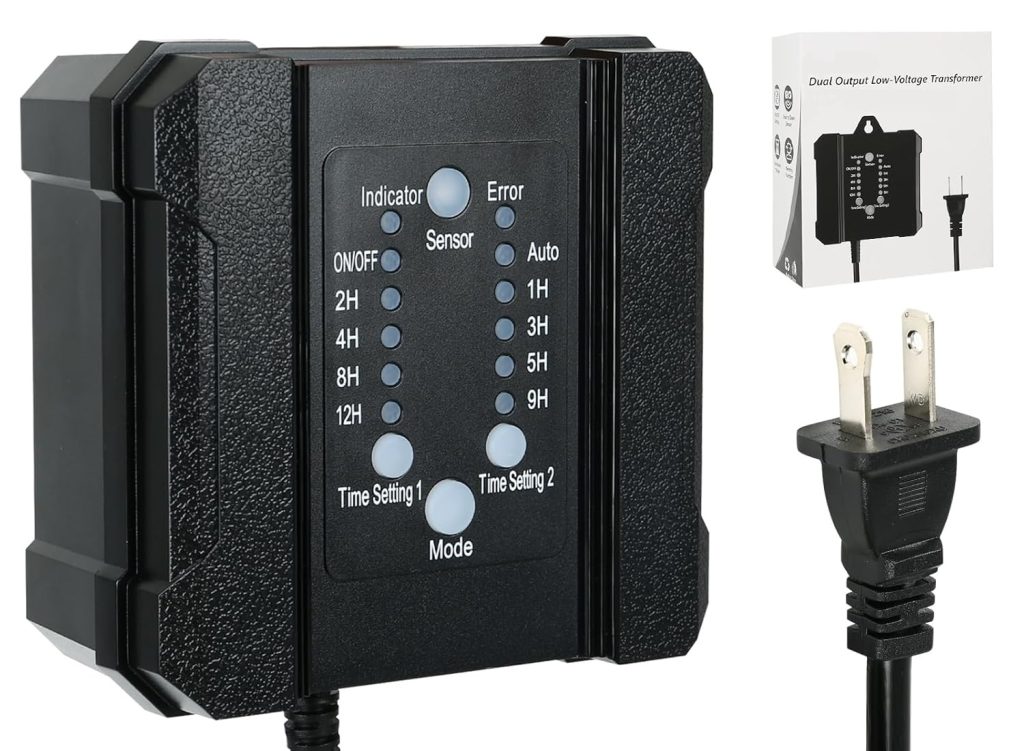
If you are lighting an elaborate garden path or accentuating various decorative features scattered throughout a vast property, consider multiple transformers placed strategically around different zones. This ensures that each area receives adequate voltage and reduces potential losses over long-distance wiring runs. Moreover, it’s worth considering expansion plans for future landscaping projects when selecting transformers now, as upgrading can be costly and time-consuming.
Applying Transformer Sizing Guidelines to Real-World Scenarios
Consider the case of a small residential garden, where you may have seven 20W path lights and four 35W spotlights, giving a total wattage of 280W. Following the 125% rule, you would need a transformer of at least 350W.
This allows for optimal operation while leaving room for potential additions in the future. However, if we consider the scenario of a large commercial property with extensive landscape lighting involving several hundred watts worth of lighting fixtures spread widely across the area, choosing an appropriately sized transformer becomes more complex.
It might require multiple transformers located in different zones to account for wiring length and minimize voltage drop. For example, three transformers, each with a capacity of 600W, could be necessary to effectively light various sections without overloading any single unit.
Transformer sizing in landscape lighting is not merely about meeting power requirements but also ensuring operational efficiency, aesthetic appeal, and future scalability. A well-chosen transformer size significantly contributes to the performance and lifespan of your entire lighting installation.
Tips on Maximizing the Efficiency of Your Landscape Lighting
Proper Installation: The Foundation of Efficiency
When it comes to landscape lighting, nothing beats a well-executed installation. Meticulously considering wire routes, fixture placement, and proper sealing methods will go a long way in ensuring the efficiency of your lighting. The transformers should be installed in protected locations to minimize their exposure to the elements, which can significantly reduce their lifespan and efficiency. Furthermore, ensure that all connections are firmly secured to avoid any potential power losses.
Optimal Load Distribution: Harnessing Power Where Needed
Load distribution is an essential aspect of enhancing the efficiency of your landscape lighting. To achieve this, consider dividing your fixtures into zones based on their power requirements and proximity. By running separate cables from the transformer to each zone, you minimize voltage losses over cable lengths and ensure that each light fixture receives adequate power for optimal performance.
Eco-Friendly Bulbs: Optimize Energy Use with LED Lights
Incorporating LED lights into your landscape lighting will significantly improve energy efficiency. LEDs use less energy than traditional incandescent bulbs but provide comparable or even superior luminosity levels. Moreover, they have a longer lifespan, which means fewer replacements and thus reduced maintenance costs.
Utilizing Timers and Photocells: Automate for Economical Use
Automating your landscape lighting can also contribute towards its efficiency. Timers allow you to program when your lights turn on or off – ensuring they only operate when necessary, reducing unnecessary energy usage. Photocells are another fantastic investment; these devices detect changes in natural light levels, turning off your fixtures during daylight hours and reactivating them as darkness falls.
Conclusion: What Size Transformer Do I Need for Landscape Lighting?
Choosing the right size transformer for your landscape lighting is fundamental for an efficient, reliable system. However, the journey doesn’t end there. Implementing the outlined tips, such as proper installation, optimal load distribution, using eco-friendly bulbs, and utilizing timers and photocells, will offer an additional layer of efficiency, enhancing not only the functionality of your landscape lighting but also its aesthetic appeal. Remember, a well-lit landscape is a beautiful one – let your creativity shine as you brighten your space for all to admire in awe.
You may also be interested in the following posts: