
Conventional Wire Gauge for Landscape Lighting
The Shining Path: Landscape Lighting Explained
Landscape lighting, when done artfully and expertly, can transform an ordinary outdoor space into a breathtaking spectacle when the sun goes down. By casting light onto steps, pathways, trees, and architectural details of your home or business premises, it not only enhances safety and visibility but also amplifies the beauty of nature and brings the outdoors to life at night. It is an auspicious fusion of aesthetics and functionality that has become an intrinsic part of modern landscaping techniques.
This magical lighting isn’t just about inserting a bunch of light fixtures into your yard. It involves strategic positioning, careful planning, and a deep understanding of how light can evoke emotions by highlighting certain elements while subtly concealing others. The aim is to guide the eye naturally from one focal point to another in a way that feels both spontaneous and meticulously orchestrated.
Moreover, landscape lighting encompasses a wide array of options, from low-voltage LEDs for delicate ambient glow to high-power spotlights for bold highlights or shadow play on larger features. This panorama reflects different levels of brightness, which in turn create desired moods ranging from tranquil serenity to dramatic intensity.
No less significant are technological factors such as automated sensors for dusk-to-dawn operation or motion detection, wireless control systems that allow you to adjust brightness levels or change colors from your smartphone, or even solar-powered units for those seeking an eco-friendly solution.
However glamorous it may appear on the surface, though, successful implementation calls for technical proficiency, which includes comprehension of electrical principles, particularly those concerning wire gauge selection for safe installation.
The Shining Thread: Why Wire Gauge Matters
As you venture into the realm of landscape lighting installation – whether you’re a DIY enthusiast or a professional electrician – one crucial aspect you need to grasp firmly is the concept of wire gauge. This is a standard measure of the diameter of an electrical wire, and it plays a pivotal role in determining how efficiently electricity flows to your light fixtures.
Choosing the correct wire gauge is not just about ensuring that your lights function properly; it’s also about safety. Incorrectly gauged wires can lead to electrical fires as they may overheat if they are not thick enough to carry the amount of current being drawn by your lighting setup.
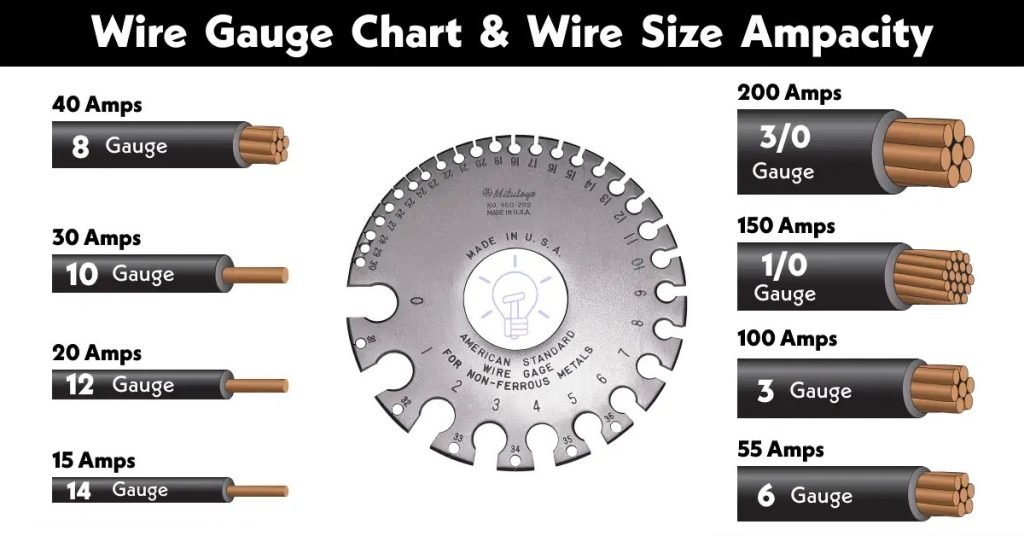
The reason for this lies in Ohm’s law, which states that resistance in an electric circuit is directly proportional to the length and inversely proportional to the cross-sectional area of the conductor. Therefore, a wire with a larger diameter (lower gauge number) will have a lower resistance, resulting in lesser heat generation and energy loss.
In addition, different types of lights require different amounts of power. Low-voltage LEDs may work flawlessly on thinner wires, while high-powered floodlights might necessitate heavy-duty cables. Oversizing or undersizing can lead to inefficient power consumption or even damage your lights over time due to voltage drops or surges, respectively.
Finding the optimal balance between these factors depends on deep knowledge and thoughtful consideration, which we will explore further as we delve into this comprehensive guide about selecting, understanding, and safely using appropriate wire gauges for landscape lighting.
Delving into the Intricacies of Wire Gauge
Demystifying Wire Gauge: An Essential Player in Electrical Conductivity
The term wire gauge, often perplexing to many, refers to the diameter or cross-sectional area of a wire. Gauges are standardized measurements that ascertain how much electrical current a wire can safely carry. The system is counterintuitive in its numerical arrangement, as smaller numbers correspond to thicker wires, and inversely, larger numbers denote thinner wires.
Wire gauge plays a central role in determining electrical conductivity. As an analogy, consider water flowing through pipes. In this case, the pipe can be likened to a wire and water to electric current. A larger pipe (lower gauge number) will allow more water (electricity) to flow through it compared with a smaller pipe (higher gauge number).
It’s worth noting that there is an inverse relationship between resistance and cross-sectional area – as the area increases, resistance decreases. This means that wires with larger gauges (smaller diameters) have higher resistance and thus conduct less electricity, while those with smaller gauges (larger diameters) have lower resistance and hence conduct more electricity.
This fundamental principle underscores the importance of choosing an appropriate wire gauge for your landscape lighting project. Failing to do so might result in inefficient lighting due to insufficient power supply or potential safety hazards due to overloading.
The Crucial Impact of Wire Gauge on Performance and Safety
In landscape lighting design, where aesthetics are paramount, selecting the correct wire gauge is critical for performance optimization. A suitable wire size ensures adequate voltage reaches each light fixture, thereby delivering optimal brightness levels across your landscape.
Low-voltage lights, typically installed outdoors, are sensitive to variations in voltage supply, which arise from poor selection of wire size; too small a diameter might lead to notable voltage drop over distance, resulting in dimmer lights further from the power source. Conversely, a wire that is too large for your needs may not be cost-effective and might lead to unnecessary expenditure. However, performance is just one side of the coin.
Safety is equally, if not more, important in electrical installations. A wire that is too small could overheat if overloaded with a higher current than it can handle, which may ignite a fire. Additionally, using an inappropriate wire gauge could lead to premature failure of light fixtures due to excessive voltage drop or prove damaging to transformers by causing them to operate inefficiently. Thus, understanding and correctly applying the concept of wire gauge can help circumvent these issues, thereby ensuring safe and effective operation of landscape lighting.
The process of selecting an appropriate wire gauge involves striking a balance between delivering sufficient power for optimal light performance while ensuring that safety protocols are not compromised. This pivotal choice influences not only the immediate visual impact but also the longevity and safety of your landscape lighting system.
Factors Influencing the Choice of Wire Gauge
Power Requirement and Wire Gauge: An Inextricable Link
Understanding the power requirement of your light fixtures is fundamental to choosing the proper wire gauge. The energy that each light fixture necessitates directly impacts the thickness or gauge of wire needed. This correlation exists because thicker wires allow for more current to flow through, accommodating higher wattage fixtures.

To elucidate, consider a low-voltage landscape lighting system that typically operates at 12 volts. If your collective fixtures require 200 watts, you would need a thicker wire, say 12-gauge, to safely carry this load without overheating. However, if your entire system only requires a modest 60 watts in total, a thinner wire such as a 16-gauge would suffice.
Keep in mind that when wiring for multiple lights on one line or ‘run’, you must take into account the combined wattage of all lights along that run. Overloading a wire with too many high-wattage lights can lead to overheating and potential electrical fires; hence gauging this correctly is paramount.
Distance from Power Source: The Conundrum of Voltage Drop
The distance from your power source to your light fixtures significantly influences voltage drop and thus affects your choice of wire gauge. Simply put, over longer distances electricity loses some amount of force or ‘pressure’, leading to less voltage reaching the light fixture – this phenomenon is known as voltage drop.
Calculating voltage drop involves factoring in the total length of each run from transformer to fixture as well as considering the aforementioned total wattage on each run; higher loads and longer distances yield higher drops.
For instance, if you have eight fixtures requiring 20 watts each (160 watts total) spread over an expansive garden space requiring an extensive run, e.g., 100 feet, then opting for a thicker, 10-gauge wire would be wise to counter the significant voltage drop.
However, if the power source is closer to your fixtures and the wattage demand is lesser, say only 50 feet away for a total of 80 watts requirement, a thinner gauge wire like 16 or even 18-gauge could suffice. Therefore, it’s imperative that distance and load calculations are done accurately before purchasing your wires.
Environmental Considerations: Weathering the Elements
The choice of wire gauge in landscape lighting doesn’t merely hinge on electrical requirements. Environmental conditions such as climate, soil type, and physical wear from gardening activities also have a substantial role to play.
Weather can affect both the lifespan and performance of your landscape lighting wires. For instance, regions experiencing extreme temperatures – scorching summers or freezing winters – would benefit from thicker gauges, as these withstand temperature-induced expansion and contraction better.

Soil composition is another key factor. Certain soils may have corrosive properties that can deteriorate wiring over time. As such, locales with such soil types may need thicker or specially coated wires that offer heightened resistance against corrosion.
Consider physical disturbances. If you live in an area where frequent gardening activities like spading occur or where animals are prone to digging up soft ground, opting for thicker gauges buried deeper would provide added durability against accidental breakages.
Through these illustrations, it’s evident that selecting an optimal wire gauge for landscape lighting involves meticulous considerations extending beyond mere electrical capacity. It’s an artful blending of technical specifications with geographical insight – a synergy of science with circumstance.
The Most Commonly Used Wire Gauges in Landscape Lighting
A Brief Overview of 12, 14, and 16 Gauge Wires
Among the myriad wire gauges available for varied applications, three specific gauges – namely, 12, 14, and 16 – are frequently chosen for landscape lighting. This preference stems from the balance of efficiency and economy these gauges offer for most common installations.
The numerical reference to gauge may seem counterintuitive at first: a lower number denotes a thicker wire with greater capacity to carry electrical current. Each of these wire gauges presents their own unique strengths and opportunities.
Selecting the right one is contingent upon understanding their capabilities in relation to your landscape lighting project’s requirements, such as power load and distance from the power source.
An In-Depth Look at the Robust and Reliable: the 12-Gauge Wire
The twelve-gauge wire often emerges as an ideal choice when confronting larger projects or installations spanning long distances. Its thick diameter ensures minimal voltage drop across lengthier stretches, providing consistent power to light fixtures positioned even at considerable distances from the source.
However, this robustness comes with a slightly loftier price tag compared to its thinner counterparts. And while it’s more than capable of handling heavier loads safely, it may be overkill for smaller-scale projects where a lighter gauge could suffice without compromising on performance or safety.
Striking a Balance: Profiling the Versatile 14-Gauge Wire
The fourteen-gauge wire adeptly strikes a balance between performance and affordability, making it an appealing choice for many homeowners. It caters efficaciously to medium-sized landscape lighting projects that don’t necessitate the hefty resources of a twelve-gauge but demand something more substantial than sixteen.
Furthermore, its mid-range diameter allows for moderate voltage drop control over reasonable distances without being excessively bulky or expensive. This versatile nature makes it an often-recommended choice for standard landscape lighting installations.
Light but Mighty: Unpacking the 16-Gauge Wire
The sixteen-gauge wire, the thinnest among our trio, is a cost-effective alternative suitable for smaller, low-power landscape lighting applications. Its slim profile and lower cost make it popular among homeowners wanting to add ambient lighting to compact gardens or patios without straining their budget.
While sixteen-gauge wires handle less current than their thicker counterparts, they serve sufficiently in scenarios with relatively short distances between power sources and light fixtures and lower cumulative wattages. However, be conscious of voltage-drop when using this wire over longer spans or with higher-powered lights.
Rarely Known Details about Landscape Lighting Wire Gauges
Unearthing the Uncommon: Useful Gauges for Specific Situations
While 12, 14, and 16-gauge wires are extensively used in landscape lighting, there exist other gauges that, while lesser-known, can prove advantageous in certain scenarios.
One such instance is the use of low-voltage LED lights. These luminous entities, celebrated for their energy efficiency and longevity, typically require less power to operate compared to their incandescent or halogen counterparts.
In practical terms, this reduced power demand allows for the utilization of smaller wire gauges without jeopardizing performance or safety. For instance, an 18-gauge wire might suffice for a small array of low-wattage LED fixtures. This smaller wire gauge could yield benefits in terms of cost savings on materials and potentially easier installation due to its lighter weight and increased flexibility.
However, one must exercise caution when venturing beyond standard practices. It’s crucial to always calculate voltage drop carefully when using smaller gauge wires to prevent dimming lights or overheating wires. A licensed electrician should always be consulted when in doubt.
Moreover, another uncommon scenario may call for larger-than-standard wire gauges, such as an 8-gauge wire. This might be required if you have a substantial amount of high-wattage lights located a significant distance from your transformer.
Remember that these scenarios represent exceptions rather than norms; they necessitate careful planning and meticulous execution to ensure safe and effective lighting solutions.
The Mettle of Metal: Impact of Wire Material on Gauge Selection
The material composition of a wire holds immense significance not only on the performance but also influences the selection of gauge size for your landscape lighting project. The two most common materials used in wire manufacturing are copper and aluminum. Each material possesses unique properties that affect its electrical conductivity, durability, cost, and its appropriateness for various applications.
Copper wire is renowned for its superior electrical conductivity compared to aluminum. This superior conductivity permits the use of a smaller gauge copper wire to transmit the same amount of power as a larger gauge aluminum wire. For example, a 14-gauge copper wire might be equivalent to a 12-gauge aluminum one in terms of power transmission capabilities.
Aluminum wires, although less conductive than copper ones, are lighter and less expensive. They are often utilized for long-distance transmission or large-scale projects where cost-effectiveness becomes a paramount consideration. When using aluminum wires, it’s essential to account for their lower conductivity by opting for larger gauge sizes than you would choose if using copper.
However, one must be cognizant of the fact that aluminum is more susceptible to oxidation and may require special connectors or treatments to prevent corrosion. Moreover, it’s worth noting that although lighter in weight, aluminum is not as durable as copper, leading potentially to increased vulnerability when subjected to harsh environmental conditions.
The selection of both wire material and appropriate gauge size forms an integral part of landscape lighting design, necessitating careful consideration based on factors such as power demand, distance from source power, and budgetary constraints, among others.
Summary of the Luminous Journey
In the course of our exploration within this paper, we journeyed through the intricate world of landscape lighting, delving deeply into the nuances that determine optimal performance, safety, and aesthetic appeal. We explored the concept of wire gauge and expounded on its relevance in electrical conductivity, thereby forming an understanding of how it influences the performance and longevity of landscape lights.
Our venture led us to analyze the crucial factors that determine appropriate wire gauge selection: power requirements of light fixtures and distance from power source to light. These are not mere trivial details but pivotal points that can either enhance or diminish your landscape lighting’s efficiency and stability.
With a clear understanding now ingrained in us, we can confidently say that different wattages necessitate different gauges, a fact underscored by our examination. Moreover, environmental conditions must never be overlooked. From weather conditions to soil type, each plays a significant role in dictating your choice for an appropriate wire gauge. No two landscapes are alike; hence personalizing our selection process ensures a well-lit garden or yard.
The Wire Gauge Landscape: A Diverse Territory
We canvassed through commonly used wire gauges: 12-gauge wires marked their territory as sturdy troops capable of handling higher wattages over longer distances; 14-gauge wires stood out as versatile warriors providing balance between strength and flexibility, while 16-gauge wires claimed their domain where lower voltage fixtures reside in closer proximity to power sources. The terrain expanded further as we highlighted uncommonly known specifics, such as rare but useful gauges for low-voltage LED lights and factors like wire material (copper vs aluminum), which subtly but surely influence our decision-making process.
Conclusion: What Wire Gauge Is Best for Landscape Lighting?
To conclude this comprehensive disquisition, we can affirm that there’s no ‘one-size-fits-all’ answer to the question posed at the outset: ‘What wire gauge is best for landscape lighting?’. It relies upon a multifaceted evaluation of several interdependent variables as discussed.
The beauty of landscape lighting lies not only in the glow it casts on your property but also in the harmonious blend of technical and aesthetic aspects that go into creating that perfect ambiance. Your understanding of these elements, amplified by the knowledge shared here, ultimately forms a resilient foundation upon which to build your very own luminous wonderland.
As we leave you on this note, we hope you carry forward this newfound enlightenment, enabling you to make well-informed choices and truly shine your exterior spaces with brilliance and flair. Remember, every detailed decision contributes to painting a brighter picture. And isn’t that what good lighting is all about? A brighter world indeed.
You may also be interested in the following posts: