
Unveiling Voltages: A Guide to Outdoor Landscape Lighting
An Introduction to Outdoor Landscape Lighting
In the realm of exterior aesthetics, outdoor landscape lighting stands as a pivotal element, transforming mundane or overlooked spaces into breathtaking scenes of dramatic beauty. It is a kind of nocturnal magic that allows homeowners and decorators to paint with light, highlighting architectural features, garden structures, pathways, and more.
As the Sun slips beneath the horizon, this artful lighting brings an enchanting glow that invites exploration and adds a sense of depth to the property. Landscape lighting serves a multitude of purposes beyond mere aesthetics.
It also enhances safety by lighting up dark paths or steps, which could otherwise be hazardous in low visibility conditions. Additionally, it augments property security by deterring potential intruders and making dark corners less inviting for them.
Moreover, expertly executed landscape lighting can increase property values by improving overall visual appeal. It allows homeowners to extend their living space outdoors after sunset – offering opportunities for nighttime gardening or al fresco dining under subtly lit foliage.
Yet for all its charm and function, this form of outdoor décor is not merely about placing lights haphazardly around one’s yard. Rather, it involves understanding various factors such as light directionality, color temperature, and, above all, voltage.
The Power Behind the Glow: The Crucial Role of Voltage
Voltage is the electrical force that drives an electric current between two points – it’s often referred to as electrical potential difference in technical parlance. In simpler terms, consider it as the ‘pressure’ that pushes electricity through wires just like water being pushed through pipes.
In outdoor landscape lighting setups, voltage plays a critical role both in terms of functionality and efficiency. Working much like horsepower does in an engine, voltage determines how bright your lights can shine (power output), how many lights can be chained together (load capacity), and even affects a lamp’s color temperature and rendered color accuracy.

Appropriate voltage is not a mere issue of aesthetics or power; it’s equally significant for safety. Outdoor spaces are susceptible to moisture and extreme weather conditions, thus using the right voltage can help mitigate risks such as electrical shocks, overheating, or fire hazards associated with outdoor lighting fixtures.
Furthermore, choosing the correct voltage for your landscape lighting also has implications for energy consumption and cost-effectiveness. As is well known, energy efficiency is not only beneficial for cutting down on utility bills but also contributes towards reducing our carbon footprint in the broader context of environmental sustainability.
In essence, voltage is like the heartbeat of an outdoor landscape lighting system – regulated yet powerful; unseen yet vital. Understanding its role forms the bedrock of planning a successful and radiant transformation of your nightscape.
Understanding Voltage in Electrical Systems
Defining Voltage: The Electric Potential Difference
Voltage, in the simplest terms, is the electric potential difference between two points. It can be likened to the pressure that drives an electrical current through a circuit. In fact, it’s often described as electrified ‘pressure’. The unit of measurement for voltage is volts (V), named after Alessandro Volta, who made significant contributions to the field of electricity.
More technically speaking, voltage measures the work done per unit charge as a charge moves from one point to another along an electric circuit. It’s a measure of energy transfer. To elucidate further, imagine climbing up a hill – you exert energy to overcome gravitational pull and reach higher elevations.
Similarly, in an electrical system, energy is required to move electric charges against an electric field. Voltage can exist without current – consider a battery that isn’t connected to anything but still holds voltage; however, current cannot flow without voltage because it’s this ‘electric pressure’ that pushes electrons around a circuit, causing them to flow.
An Integral Component of Electrical Systems: Voltage
Voltage plays an indispensable role in any electrical system. It acts as the powerhouse driving the electrons through electrical circuits – essentially pushing or forcing them around. Without adequate voltage levels, electrical appliances may not function correctly or even at all because there wouldn’t be sufficient force propelling those electrons.
Just like water traveling through pipes needs pressure for movement and distribution, so too do electrons within electric wires need voltage for their transit and propagation. Whether we’re talking about small devices like mobile phones or large pieces of machinery like industrial generators, they all require suitable voltages for efficient operation.
In landscape lighting systems specifically, correct voltage ensures that lights function optimally with appropriate brightness levels and longevity. The choice between low-voltage (12V) or line-voltage (120V) systems can significantly influence the overall performance of your outdoor lighting setup.
Lighting Up Spaces: The Role of Voltage in Landscape Lighting
In landscape lighting, choosing the right voltage is paramount for creating a balanced, well-lit outdoor space. The level of voltage determines the brightness and intensity of light emitted from a fixture. Lower voltage systems generally produce softer, more ambient light ideally suited for subtle path lighting or highlighting garden features.

On the other hand, higher-voltage systems can provide intense, bright light covering larger areas and can be employed when bold and powerful lighting is needed – perhaps to illuminate a large backyard or for security purposes. Voltage also influences energy efficiency – lower voltages tend to consume less electricity, thereby proving more energy-efficient.
However, they may require special transformers to step down the household’s standard line voltage (usually 120V) to match their low-voltage needs. The choice between low-voltage and high-voltage lighting will dictate installation procedures and safety measures to be adopted since working with electricity always involves certain risks.
A Matter of Balance: Voltage in Landscape Lighting Systems
Achieving an ideal balance in landscape lighting is one aspect where understanding voltage becomes crucial. An efficient outdoor lighting system ensures all fixtures receive adequate electrical supply without any electric potential drops that could diminish their output or shorten their lifespan.
Voltage drop usually happens over long distances or when too many lights are connected to a single circuit without suitably balanced load distribution. Thus, understanding voltage helps anticipate these issues during design and installation stages, enabling electricians & homeowners to optimize their outdoor landscape lighting setups for the best performance and longevity.
Comprehending what voltage is – its definition & role in electrical systems – is indispensable when planning out your landscape lighting project. Be it deciding which fixtures are suitable for your needs or how they should be wired together for maximum effect, it all pivots on a solid grasp of voltage and its crucial role in electrical systems. A well-designed landscape lighting system, with the right voltage at its core, not only enhances visual appeal but also improves the safety and functionality of outdoor spaces.
Standard Voltage Levels for Outdoor Landscape Lighting
Understanding Low-Voltage (12V) and Line-Voltage (120V) Systems
In the realm of outdoor landscape lighting, two primary voltage levels are commonly employed: low-voltage (12 volts) and line-voltage (120 volts). These dissimilar systems have their distinct uses, advantages, and drawbacks, which we’ll delve into in greater depth.
Low-voltage landscape lighting utilizes a transformer to reduce the standard 120-volt household current to a safer 12 volts. This system is favored for residential use due to its inherent safety benefits. The lower voltage minimizes the risk of electric shock should the wiring be accidentally cut or damaged. Moreover, installation is typically more straightforward than that of line-voltage lights, as it requires fewer complex cabling connections.
On the contrary, though, lies the line-voltage lighting system that operates directly on household current without any need for a transformer. Emitting a powerful luminosity over larger areas, these lighting systems become an ideal choice for commercial properties or expansive gardens where extensive light diffusion is required.
A Comparative Study: Low-Voltage versus Line-Voltage Systems
Comparatively speaking, both low-voltage and line-voltage systems present their unique qualities, and deciding between them ultimately depends upon specific user requirements.
Low-voltage systems offer significant benefits in energy efficiency. They consume less power than their higher voltage counterparts, which results in decreased energy bills over time – a highly desirable quality for homeowners wanting to maintain aesthetic appeal without dramatically increasing electricity costs.
Safety too leans more towards these low-volt options; they minimize risks associated with electrical faults or mishaps during installation or maintenance. As these systems operate at a lower voltage level, they also generate less heat, making them less likely to cause burn injuries or fire hazards.
Line-voltage lights outshine when it comes down to providing bright, intense lighting over large areas. They are considerably more robust and durable, making them well-suited for higher-traffic outdoor areas where they may be exposed to harsh weather conditions.
However, line-voltage systems require a more complex installation process involving junction boxes and conduits adhering strictly to the National Electric Code guidelines. This typically necessitates hiring a professional electrician, escalating overall project costs.
Furthermore, these higher-voltage systems consume significantly more power, which can manifest in increased electricity bills. There’s also a higher risk of electrical shock if the wiring gets damaged – safety precautions must be meticulously observed during installation and maintenance.
In summation, each system bears its unique attributes, catering to varied situations and user needs. The choice fundamentally rests upon the balance between safety, power efficiency, luminosity requirements, and cost considerations.
Finding the Spark: Factors influencing Voltage Choice in Landscape Lighting
In determining the most suitable voltage for your outdoor landscape lighting, there are several factors to consider. Firstly, the type and size of the lighting area play a critical role. Larger areas may require higher-voltage systems capable of delivering more power to ensure sufficient lighting.
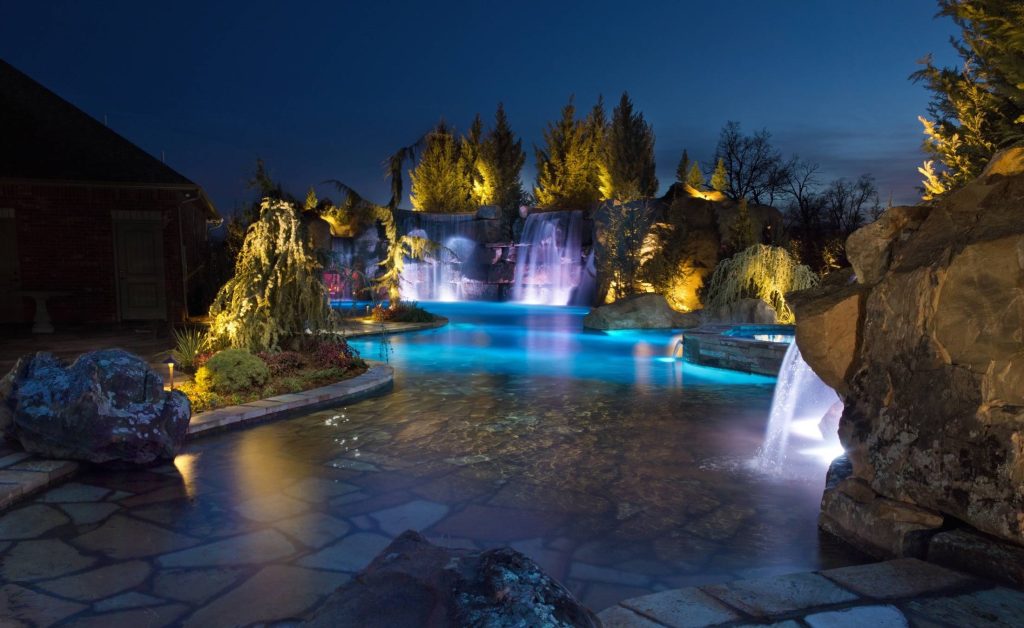
Equally crucial is your desired brightness level, which directly influences your voltage choice. Safety considerations are paramount when dealing with electrical systems, particularly in outdoor settings where environmental elements present additional challenges. Low-voltage systems are generally safer due to their lower shock risk.
In our increasingly energy-conscious world, it’s prudent to consider energy efficiency when selecting a voltage system. Lower voltages tend to be more energy-efficient but may sacrifice brightness and coverage.
Diminutive Dynamo: Low-Voltage Landscape Lighting System
The low-voltage landscape lighting system operates at 12V, making it safer and more energy-efficient than its higher voltage counterpart. It consists of fundamental components such as transformers – which step down standard household current to a safer 12V – cables for transmitting electricity, and various types of fixtures offering different styles and levels of lighting. Installing a low-voltage landscape lighting system can often be a do-it-yourself endeavor requiring minimal technical expertise as compared to line-voltage systems that necessitate professional intervention due to safety concerns.
An alluring suite of benefits accompanies these systems; they offer safety through reduced shock risks, versatility through an array of fixture options catering to diverse aesthetic needs, and laudable energy-efficiency levels. However, it’s important not to omit certain limitations, including distance restrictions, as longer cable runs can lead to significant voltage drop resulting in dimmer lights, alongside constrained power output.
High-Powered Lighting: Line-Voltage Landscape Lighting Systems
For situations requiring powerful lighting over larger areas, line-voltage landscape lighting systems running at 120V are a suitable option. These systems comprise components like junction boxes, conduits, and a variety of fixture types. Installation of line-voltage systems is more complex due to the higher shock risks associated with their operation.
As such, it’s prudent to engage professional electricians for these installations. Despite their higher energy consumption and increased safety concerns, line-voltage systems provide unparalleled lighting intensity and larger area coverage – factors that may be paramount depending on the specific requirements of a project.
Shedding Light on the Unseen: Rarely Known Details about Outdoor Landscape Lighting Voltage
There are certain oft-overlooked aspects regarding voltage in outdoor landscape lighting that bear consideration. The length and thickness of cables used can drastically influence voltage drop across your lighting system, with longer or thinner cables leading to greater voltage drop and subsequently diminished light output.
Transformers play an indispensable role in outdoor lighting by adjusting voltage levels to safe standards applicable for each particular system. Moreover, achieving balanced load distribution is critical for optimal performance across all fixtures in your landscape lighting setup.
Guiding Your Journey: Tips for Choosing the Right Voltage for Your Outdoor Landscape Lighting Project
Choosing the right voltage for your outdoor landscape lighting project need not be as daunting as it might seem at first glance. By considering factors such as area size, desired brightness level, safety considerations, and energy efficiency, you can make an informed decision.
Conclusion: What Voltage Occurs in Outdoor Landscape Lighting?
Understanding voltage in outdoor landscape lighting is essential to ensuring optimal performance and aesthetic appeal while upholding safety standards. While there may be various guidelines and rules to navigate through this process, remember that every journey begins with a single step – or perhaps more likely, a single spark!
With knowledge as our guiding light into this fascinating world of luminary landscapes, we can confidently light our paths and let our gardens glow with resplendent beauty. Let’s look forward to a brighter, safer, and more energy-efficient future in outdoor landscape lighting!
You may also be interested in the following posts: