
Do LED Tube Lights Outshine Fluorescent Tube Lights?
Introduction to the Bright World of Lighting
Lighting is an indispensable element of our world. From enhancing visibility to highlighting aesthetics, it has ceaseless roles to play. Out of the galaxy of lighting options available, two stand significantly prominent – fluorescent tube lights and LED tube lights. Each offers unique advantages and features that cater to various needs across residential, commercial, and landscape lighting scenarios.
The Luminous Tale of Fluorescent Tube Lights
Fluorescent tube lights have been a common name in the realm of lighting for almost a century. Invented by American physicist George Inman in the late 1930s under General Electric, these lights quickly gained popularity for their energy efficiency and long lifespan compared to incandescent lamps.
The working mechanism involves an electric charge being sent through mercury vapor within the tube, which in turn produces ultraviolet light. This invisible light then strikes a phosphor coating on the interior surface of the lamp, leading it to glow or fluoresce.
LED Tube Lights: A Beacon of Technological Evolution
On the other hand, light-emitting diode tube lights are a newer entrant on this stage but have revolutionized lighting technology with their unparalleled energy efficiency and superior longevity. LEDs operate via semiconductor diodes that emit light when charged particles combine together, releasing energy in the form of photons – this phenomenon is scientifically known as electroluminescence, quite different from fluorescents’ reliance on fluorescence.
Brightness: The Cornerstone of Effective Lighting Solutions
In any conversation about fluorescent or LED landscape lighting solutions or indoor ambience creation, brightness holds indispensable importance. It could be seen as an equivalent to volume in sound; brightness defines how much luminous power one perceives from a source irrespective of its distance from them – a crucial factor shaping our visual experience of a space.
Navigating through the Expanse of Brightness
The brightness of a light source is typically measured in lumens, not to be confused with wattage, which refers to the power consumption. The higher the lumens, the brighter the light output. Thus, when pitting fluorescent tube lights against LED tube lights or any other kind of lighting for that matter, understanding lumens becomes vitally imperative.
However, brightness isn’t solely about lumens; factors like color temperature and beam angle too have considerable influence on how bright a light appears to human eyes. In the forthcoming sections we will delve deeper into these characteristics and compare how fluorescent tube lights stack up against LED tube lights on multiple dimensions, including brightness.
Understanding Brightness in Lighting
The Intricacies of Brightness: Defining and Measuring Luminosity
In the realm of lighting, whether it pertains to LED tube lights or fluorescent tube lights, brightness is a term cohesively used to delineate the perceptual intensity of light. It is an essential component that determines how well we perceive the world around us. However, contrary to common belief, brightness is not measured in watts but rather in lumens.
Lumens are units that quantify the total amount of visible light emitted by a source, thereby serving as an accurate measurement for literal brightness. For instance, a candle provides around 12 lumens, whereas standard LED tube lights can offer upwards of 1500 lumens. Thus, when considering landscape lighting or any other form of lighting solution, evaluating lumen output becomes imperative.

Furthermore, wattage plays a pivotal role in this domain too. Although it’s frequently misconstrued as a unit for measuring brightness due to historical reasons surrounding incandescent bulb usage patterns, wattage merely measures power consumption or energy used by a bulb over time.
Analyzing both these parameters collectively can offer remarkable insights into the efficiency and overall performance of lighting solutions such as LED tube lights and fluorescent tube lights.
The Factors Affecting Perceived Brightness: Color Temperature and Beam Angle
Perceived brightness does not solely depend on lumens and watts but also hinges upon various other factors like color temperature and beam angle. Color temperature modulates how warm (yellow) or cool (blue) light appears – it’s gauged on the Kelvin scale (K).
Fluorescent tube lights tend to exhibit cooler color temperatures hovering around the 5000K mark, while LED tube lights often provide more versatility with options ranging between warm (3000K), neutral (4000K), and cool (6000K) lighting. This temperature subtly influences the perceived brightness. For instance, cooler light may appear brighter than warmer light even if they boast similar lumen outputs, thereby significantly impacting their effectiveness in different settings such as landscape lighting or indoor illumination.
Conversely, beam angle – the extent of light spread from its source – is another critical aspect. A narrower beam angle focuses light more intensely on a smaller area, which can make it appear brighter than a light with a broader beam angle spreading the same amount of lumens over a larger area. Therefore, in order to comprehend and assess brightness effectively, it’s crucial to examine these factors alongside lumens and wattage to ensure optimal luminosity for any given application.
Overview of Fluorescent Tube Lights
A Step Back in Time: The Genesis and Evolution of Fluorescent Tube Lights
Fluorescent tube lights have a rich history that spans over a century. First introduced in the mid-1930s, these lights revolutionized the lighting industry with their efficiency. The journey began when Peter Cooper Hewitt invented the mercury-vapor lamp. This novel concept paved the way for later innovations such as fluorescent tube lights.
The popularity of fluorescent lighting saw a significant rise post World War II, becoming an integral part of commercial, industrial, and residential settings. However, despite their dominance in the past, traditional fluorescent tube lights have witnessed fierce competition from LED tube lights in recent years. With advancements in technology and an increased focus on energy efficiency and sustainability, landscape lighting has moved towards more eco-friendly options like LED lights.
Understanding the Mechanics: How Do Fluorescent Tube Lights Work?
Operating on a fundamentally different principle than incandescent lamps, fluorescent tube lights work by ionizing mercury vapor inside a glass tube. This ionization generates invisible ultraviolet light, which further excites the phosphor coating on the inner side of the glass tube to emit visible light.
The entire process begins with an electric current passing through electrodes at each end of the glass enclosure. The interaction between electric current and cathode heating creates free electrons, which collide with mercury atoms, resulting in ionization and emission of ultraviolet light.
The Key Components: Mercury Vapor & Phosphor Coating
The two main components involved in producing light in fluorescent tubes are mercury vapor and phosphor coating. Mercury is used because its atomic structure readily emits UV radiation when excited by an electrical discharge – this characteristic makes it ideal for producing visible light indirectly.
Conversely, phosphor plays no less significant a role than mercury vapor – it transforms UV light into visible light. When the UV photons come in contact with the phosphor coating, they excite the phosphor particles, which then de-excite and yield energy in the form of visible light.
Determining Brightness: Luminescence Levels in Fluorescent Tube Lights
The brightness of a fluorescent tube light is largely determined by its lumen output – a measure of the total quantity of visible light emitted. In general, fluorescent tubes are considered quite bright and efficient when it comes to lumen output per wattage consumed. However, determining brightness isn’t as simple as looking at watts or lumens.
Factors such as color temperature and beam angle can significantly influence our perception of brightness. Furthermore, due to their omnidirectional nature, fluorescent tube lights often require reflectors or diffusers to direct light where it’s needed most.
Typical Luminosity: Expected Output from Common Models
Typically, a standard four-foot T8 fluorescent tube rated at 32 watts can produce around 2,600 lumens. On average, that’s roughly 80 lumens per watt – making them considerably brighter than incandescent bulbs (which only generate about 14-17 lumens per watt) but somewhat less efficient than LED tube lights, which can produce well over 100 lumens per watt depending on model and manufacturer.
Moreover, it’s important to note that while initial lumen output may be high for fluorescent tubes, they tend to depreciate over time more rapidly than LED lights. This means an aging fluorescent tube will seem less bright compared to a new one even if electricity consumption remains unchanged.
Unveiling the Journey of LED Tube Lights
Tracing back through the annals of history, light-emitting diodes were first introduced into the scientific community in the early 1960s. Initially, their scope was limited to small-scale applications such as indicator lights in a myriad of electronic devices. It wasn’t until the 1990s that blue LEDs were invented. This breakthrough innovation paved the way for white LED lights, which truly revolutionized not just landscape lighting, but lighting across all spheres.
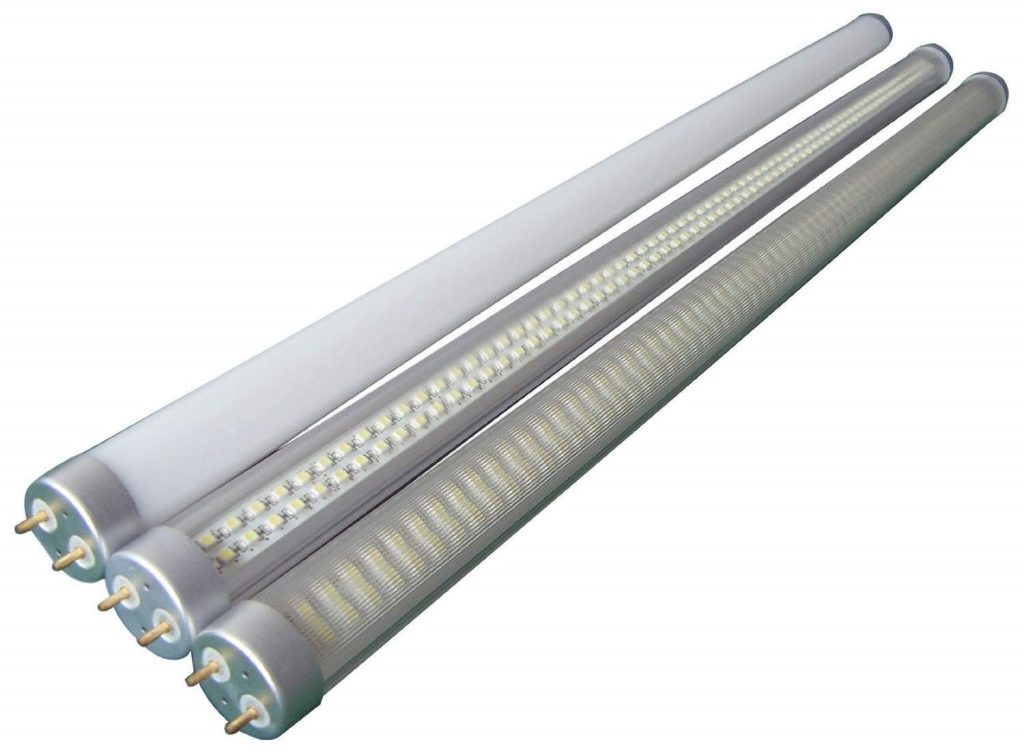
The progression from rudimentary uses to being a potent competitor to conventional fluorescent tube lights has been nothing short of extraordinary. Today, LED tube lights are celebrated not only for their energy efficiency and longevity but also for their impressive light output, making them an increasingly popular choice globally.
The Art of Lighting: How Do LEDs Produce Light?
Delving into the intricacies of how LEDs produce light involves understanding semiconductor diodes – the fundamental component at their core. Unlike incandescent bulbs that generate light through heat or fluorescent tube lights that rely on excitation of mercury vapor, LEDs operate on an entirely different principle known as electroluminescence.
When voltage is applied to an LED, electrons are able to recombine with electron holes within the device, releasing energy in the form of photons, which we perceive as light. This ability to directly convert electrical energy into light reduces wastage significantly and contributes towards their exceptional efficiency ratings.
Demystifying Semiconductor Diodes
The heart and soul of every LED tube light is a semiconductor diode that emits light when charged with electricity. These diodes are created using materials like gallium arsenide and indium gallium nitride, which carry particular atomic structures perfect for producing visible lighting.
Each diode is engineered to emit a specific wavelength (color) depending on its chemical composition and the gap of energy required for an electron to cross from the conduction band to the valence band. This scientific phenomenon, known as ‘band gap’, essentially determines color variation among different LED tube lights.
Shining a Light on Brightness Levels in LED Lights
The growing fascination with LED tube lights can be largely attributed to their high lumen output. Although early models were initially limited in brightness, technological advancements have enhanced their capability significantly. Today, we have LED tubes that range from 600 lumens to over 3500 lumens, thus catering to a diverse array of lighting needs.
It’s essential to note that while brightness is a key consideration, it’s not always about achieving maximum lumens. Factors such as color temperature and beam angle also play crucial roles in shaping our overall perception of brightness – an aspect where LEDs bring unparalleled versatility on board.
An Examination of Typical Lumen Output: What’s Common?
For residential landscape lighting or even commercial settings like offices and stores, you’ll find that average LED tube light output falls between 1600 and 2000 lumens per tube. This level of brightness suffices most ambient lighting requirements comfortably without seeming excessively bright or conspicuously dim.
In comparison with fluorescent tube lights, which offer similar lumen outputs but at higher energy costs, LED tube lights clearly demonstrate superior efficiency standards. The fact that they maintain consistent brightness levels throughout their lifespan further sets them apart in this ever-evolving realm of lighting sophistication.
Comparison between LED Tube and Fluorescent Tube Lights’ Brightness
Direct Comparison of Lumen Output per Wattage
Dissecting the Lumen Output
In the realm of luminary science, one of the most pivotal elements that determine a light’s brightness is its lumen output. This is undeniably a significant yardstick when comparing fluorescent tube lights and LED tube lights. A standard 40-watt fluorescent tube light typically delivers around 2300-2500 lumens, whereas an equivalent LED tube light generates approximately 2200-2500 lumens.
Wattage and Brightness: The Intricate Relationship
However, it’s crucial to note that wattage does not directly correspond to brightness in LED technology as it does with conventional lighting types. An LED’s brightness is dictated by the diodes’ current, not its energy consumption (wattage). Therefore, this allows LEDs to produce equal, if not superior, amounts of light while consuming substantially less power.
Brightness under Landscape Lighting Conditions
In terms of landscape lighting or large-scale lighting projects where numerous units are required, this difference in lumen output per watt becomes even more pronounced. It ultimately culminates in notable energy savings while maintaining a similar level of brightness offered by traditional fluorescent tube lights.
Impact of Longevity on Perceived Brightness Over Time
The Depreciation Dilemma with Fluorescent Lights
For many individuals, another critical factor when considering whether to opt for fluorescent tube lights or LED alternatives is their longevity and sustained brightness over time. With frequent usage, all lighting solutions will inevitably encounter some degree of luminosity depreciation – a decline in their original brilliance. However, this process is considerably more expedited in fluorescent tube lights.
The Longevity of LED Tube Lights
On the other hand, LED tube lights are acclaimed for their impressive longevity and durability. LEDs do not burn out like traditional light bulbs; instead, they undergo a process known as ‘lumen depreciation’, which is significantly slower than the rapid degradation observed in fluorescent tube lights.
Perceived Brightness over Time
Consequently, even after an extensive period of use, LED tube lights can continue to deliver high levels of brightness. Unlike their fluorescent counterparts that may necessitate more frequent replacements due to declining brightness levels, LEDs are more adept at maintaining their luminosity over time.
Cost-Efficiency and Performance Longevity
This performance longevity, coupled with reduced energy consumption, makes them a highly cost-efficient choice in the long term – even when considering their higher initial costs. Therefore, those considering landscape lighting or similar large-scale projects would do well to bear this in mind when selecting between fluorescent tube lights and LED options.
The Revealing Impact of Energy Efficiency
Energy Consumption: LED Tube vs Fluorescent Tube Lights
In the quest for more efficient and environmentally friendly lighting solutions, one cannot overlook the role energy consumption plays. LED tube lights are renowned for their energy efficiency, often outshining their fluorescent counterparts.
A standard LED tube light utilizes around 40% less energy than a comparable fluorescent tube light to produce the same lumen output. This impressive statistic becomes even more notable when you consider the high-usage environments where these lights are often employed, such as offices, factories, or landscape lighting.
Fluorescent tube lights, while not as energy efficient as LED tubes, have historically been more cost-effective than older incandescent bulbs. However, they have certain drawbacks that limit their efficiency. They rely on a process of exciting mercury vapor to produce ultraviolet (UV) light, which is then transformed into visible light by the phosphor coating lining the inside of the bulb. This process results in a significant amount of wasted energy in the form of heat.
LED tube lights operate differently from conventional fluorescent lamps by producing ‘cold’ light without generating much heat at all. The efficiency factor is derived from this ability to convert almost all power drawn into visible light with very little wasted as heat or other forms of non-useful radiation like UV rays.
The clear advantage in terms of energy consumption lies with LED technology, but what about longevity? An average LED has an operational lifetime expectation up to 50 times longer than that of traditional fluorescents; this significantly reduces maintenance costs and further contributes towards their overall better performance and cost-effectiveness.
Efficiency’s Role in Luminous Longevity
The impact on brightness over time is another aspect influenced heavily by efficiency. How so? Fluorescent tube lights tend to lose brightness gradually throughout their lifespan due to depreciation in the phosphor coating on the bulb. This decrease in brightness is gradual but noticeable, especially in environments where consistent lighting levels are required.
LED tube lights, on the other hand, maintain their brightness levels almost consistently throughout their operational life. This is attributable to their superior design and construction quality. As LED technology does not rely on a gas-filled tube or a filament that can break or become less efficient over time, LED tubes keep their brightness for much longer periods.
One interesting observation is how efficiency influences the lumen output over time. Fluorescent lights may start out brighter than LED tubes of comparable wattage but lose this advantage over time due to lumen depreciation – an issue commonly referred to as ‘lumen maintenance’.
In contrast, LED lights maintain their initial lumen output for most of their rated life span due to superior energy efficiency and robust design. The shift in perception between initial and sustained brightness can be quite profound and underscores why LED tubes are now seen as the superior choice for reliable, long-lasting lighting.
So while fluorescent tube lights may have been the mainstay for many years in numerous settings – from domestic homes to towering office spaces and sprawling landscape lighting – it’s clear that LED tube lights have surpassed them through sheer performance longevity. When it comes to overall efficiency and its impact on perceived brightness over the lifetime of a lighting fixture, LED tube lights hold the winning edge.
Other Factors Influencing the Perception of Brightness
The Intricate Dance of Color Temperature and Perceived Brightness
As we further delve into the intricacies of light perception, color temperature emerges as an influential character. It is measured in Kelvin (K) and represents the color characteristics of light. Lower temperatures (below 3000K) yield a warm, yellowish glow similar to incandescent bulbs, reminiscent of a tranquil sunset. Higher temperatures (above 5000K), on the other hand, produce cooler, bluish hues akin to natural daylight.
The role color temperature plays in perceived brightness is undeniably significant. For instance, fluorescent tube lights often operate at higher color temperatures compared to standard incandescent lamps. This cooler light frequently appears brighter to human eyes due to its resemblance to natural daylight – a phenomenon harking back to our evolutionary roots in sunlight-filled landscapes.

However, LED tube lights have an advantage here. They offer a wider range of color temperatures, from warm white (~2700K), perfect for cozy residential spaces or landscape lighting applications, through cool white (~4000K), suitable for workspaces or utility areas, all the way up to daylight equivalent (~6500K). This breadth enables consumers to tailor their lighting preferences not only in terms of brightness but also ambiance and aesthetics.
It’s important to note that despite its influence on perception, color temperature does not play a direct role in actual luminosity. A high-color-temperature light source isn’t inherently brighter than its lower-temperature counterpart; it simply appears so due to personal perceptions and environmental influences.
Beam Angle: The Unsung Hero Influencing Light Distribution and Perception
Venturing further into the realm influencing perceived brightness, one cannot overlook beam angle’s significance – particularly in specialty applications like landscape lighting or accent illumination where directed light becomes paramount. In simple terms, the beam angle is a measure of the spread of light from its source.
A narrow beam angle results in focused, intense light ideal for spotlighting or task-oriented lighting. In contrast, a wide beam angle produces diffused, softer light suitable for general or ambient lighting.
Fluorescent tube lights typically emit light in all directions (360 degrees). On the downside, much of this light gets wasted on areas not requiring illumination, and brightness can appear diminished due to diffuse distribution. On the upside, they are excellent for providing uniform ambient lighting.
LED tube lights present a win-win situation. They generally have a 120-180 degree beam angle, directing more light downwards where it’s often needed most. This design reduces wastage and increases perceived brightness without necessarily increasing actual lumens output.
However, one must tread cautiously when considering beam angle – wider isn’t always better, nor is narrower always more advantageous. It’s about appropriateness to the task at hand or ambiance desired – just like selecting an artist’s brush according to detail or coverage required on canvas.
While lumen output serves as a tangible measure of brightness in fluorescent and LED tube lights, color temperature and beam angle significantly affect how we perceive this brightness. These subtleties underscore how critical it is to understand not just the science of lighting but also its artful nuances.
A Gleam in the Commercial Sector: LED Tube vs Fluorescent Tube Lights
In the realm of commercial settings – offices, stores, retail outlets, and more – lighting plays a vital role. Not only does it ensure visibility, but it also helps shape customer experience and employee productivity. Herein, the battle between LED tube lights and fluorescent tube lights is significantly noticeable.
Taking a deeper dive into office spaces specifically, LED tube lights seem to be gaining an upper hand. Traditionally lit by fluorescent tubes famously known for their harsh light quality, many establishments are making the shift towards LED tubes. The primary rationale lies in LEDs’s higher brightness levels that enhance clarity and reduce eye strain among employees, thereby boosting their efficiency.
In retail outlets and department stores where products are on display for customers, lighting becomes even more crucial. The crisp white glow from LED tube lights tends to render colors more accurately than their fluorescent counterparts, which have a tendency to wash out colors due to their cooler color temperature. This aspect is paramount in enhancing product appeal and driving sales.
In addition, landscape lighting has seen a revolution with the advent of LED lights as well. With a far superior brightness-per-watt ratio compared to fluorescents, they perfectly light up outdoor commercial spaces like parks or restaurants’ patios while using much less power.
Let’s not ignore the maintenance aspect as well. With longer lifespans and fewer periodic replacements necessary compared to fluorescents, LED tubes minimize maintenance efforts, making them a preferred choice for commercial entities that aim for operational efficiency.
Residential Radiance: How Home Lighting Has Evolved
Switching focus from commercial settings to residential ones – homes or apartments – there has been an observable trend favoring LED tube lights over traditional fluorescent ones too. Let us explore this evolution in detail.
One major factor that homeowners consider while choosing between LEDs and fluorescents is energy efficiency, which directly impacts utility bills. While both types of lighting solutions are used in various parts of a household, it’s the LED tube lights that have an edge due to their ability to produce more light per watt consumed.
Another discernible advantage of LED tubes lies in their versatility. From task lighting in kitchens and study areas to ambient and landscape lighting, LEDs’s superior brightness, color accuracy, and directional control make them a versatile choice for varied home applications.
Consider the case of landscape lighting. With LED tubes providing brighter and more focused light, they beautifully accentuate outdoor features like gardens or patios, which is hardly achievable with diffused light from fluorescent tubes.
However, it’s not just about efficiency or aesthetics. The environmental factor plays into this preference too. LED technologies contain no toxic elements like mercury found in fluorescents, making them a safer choice for homes that host children or pets.
Residents often look at the long-term benefits while making such investments. With longer lifespans leading to reduced replacements over time and lower energy consumption keeping utility bills in check, homeowners find LED tubes a financially viable and brighter alternative to fluorescent tube lights.
Conclusion: Is LED Tube Light Brighter than Fluorescent Tube Light?
A Bright Future: Unraveling the Luminary Conundrum
In the grand scheme of lighting solutions, we have painstakingly dissected and appraised two formidable contestants: fluorescent tube lights and LED tube lights. Through our exploration, we’ve unlocked a cache of knowledge regarding their histories, workings, brightness levels, efficiencies, and impacts of factors like color temperature and beam angle on their perceived brightness.
As we delve into our conclusion, it becomes apparent that there is no clear-cut answer to our original question. The brightness between fluorescent tube lights and LED tube lights is invariably a nuanced subject, influenced by an array of factors beyond just lumens per watt.
The Luminous Verdict: Which Tube Shines Brighter?
When scrutinizing lumens per watt – the conventional measure of light output efficiency – LED tubes often outshine their fluorescent counterparts. However, this does not necessarily imply that LED tube lights are always brighter than fluorescent tube lights. In real-world applications such as landscape lighting or indoor illumination, design elements like beam angle and color temperature play critical roles in how bright our eyes perceive the light to be.
LED tube lights have an inherent advantage in scenarios requiring directional or focused lighting due to their superior beam angle control, which makes them an optimal choice for landscape lighting where precision matters. Similarly, fluorescent tube lights, with their diffused radiating pattern, offer superior ambient lighting, making them ideal for areas needing soft, widespread light.
Seeing beyond Brightness: Considering Efficiency Disparity
Besides brightness considerations, another significant factor that cannot be discounted is energy efficiency. This is where LED tube lights reign supreme, consuming substantially fewer watts for equivalent lumen output compared to fluorescent tubes while also boasting a notably longer lifespan. The financial savings over time through reduced energy consumption are substantial, making LED tubes the more economically sustainable choice.
The Landscape of Light: Future Predictions
As we continue to innovate and technology relentlessly advances, the gap between LED tube and fluorescent tube lights will likely widen. LED tube lights, being the more recent entrant in the lighting arena, still have ample room for development, pushing their brightness potential further.
The Light at the End of the Tube
So, is an LED tube light brighter than a fluorescent tube light? Essentially, it boils down to the specific needs of your lighting application. One type may shine brighter under certain circumstances; however, considering overall energy efficiency and advancements in lighting technology, LED tube lights certainly appear to hold a bright promise for our future.
You may also be interested in the following posts: