
Do LED Lights Need AC or DC? Uncover the Truth!
Shining a Light on LED Technology
The technology of light-emitting diodes, more popularly known as LEDs, is at the forefront of the modern lighting industry. Initially introduced in the early 1960s, LEDs have undergone a remarkable evolution that has seen them become woven into the fabric of our everyday lives.
From digital displays to household lighting and even horticultural applications – LEDs are everywhere around us. LED lights offer not just versatility but also superior energy efficiency and longevity when compared with traditional incandescent or fluorescent lighting.
They generate light by electroluminescence – a phenomenon wherein a material emits light in response to an electric current or a strong electric field. Unlike conventional lights, which produce a spectrum of colors that combine to form white light, LEDs emit light in specific, narrow bands of wavelengths. This characteristic gives rise to their richness and variety of colors.
Despite their widespread application and acknowledged benefits, there is still substantial confusion surrounding LED technology – especially regarding its power requirements. Many are left wondering: do LED lights use alternating current (AC), commonly supplied in most homes and businesses? Or do they prefer direct current (DC), such as what batteries provide?
This exploration becomes all the more relevant when one considers that an incorrect power supply could lead not just to poor performance but could also truncate an LED’s lifespan or even cause safety hazards such as overheating. In this post, we aim to clear up this mystery by delving into the heart of LED technology – a journey that will no doubt provide enlightening insights for both professionals navigating their way through complex installations and homeowners looking for optimized utilization.
The Importance of Deciphering Power Requirements for LEDs
Understanding the power requirements for LED lights is critical for several reasons. Primarily, knowing whether an LED light requires AC or DC current affects its performance and longevity. LEDs are semiconductor devices that respond sensitively to the characteristics of the power supplied to them. Hence, using the incorrect type of current can significantly decrease the lifespan of an LED light and degrade its performance.
Moreover, comprehension of power requirements impacts our ability to effectively integrate LEDs into different systems, be it a simple desk lamp or a complex array in an industrial setting. It can inform decisions about necessary ancillary equipment – such as drivers and transformers – and influence installation practices.
The financial implications should also not be overlooked. Incorrect use can lead to unnecessary energy waste, thereby inflating utility bills. Moreover, premature failures due to inappropriate power supplies bring with them replacement costs and could even necessitate complete overhauls of lighting systems in extreme situations. In some cases, safety concerns may also arise from improper power supply use with LED lights – making it a topic not just of interest but sometimes of importance.
As we continue our journey into this enlightening discourse on LEDs and their power requirements, we will discover not just arcane knowledge but potentially impactful practical insights too. So read on as we flip the switch and brighten up our understanding!
Understanding Basic Electricity Concepts
The Fundamentals of Alternating Current (AC) and Direct Current (DC)
To fully grasp the power requirements for LED lights, we must first delve into the world of basic electricity concepts. Central to this understanding is distinguishing between two primary types of electrical currents, namely alternating current (AC) and direct current (DC).
Alternating current, or AC, is characterized by a flow of electric charge that frequently reverses direction. Invented by the renowned scientist Nikola Tesla, AC enables the transfer of electrical energy over considerable distances without significant power loss. This makes it ideal for large-scale energy transmission in towns and cities. Most household outlets provide AC electricity due to its suitability for powering numerous appliances and its compatibility with transformers.
On the contrary, direct current (DC), as championed by Thomas Edison during his era, involves a steady flow of electric charge in one direction. This unidirectional flow makes DC ideal for devices that necessitate a stable and constant voltage supply, such as batteries, solar cells, or electronic systems where control over small voltages is required.
A Comparative Analysis Between AC and DC
While both AC and DC are fundamental to our daily lives’ functioning dynamics, there are notable differences between them that have specific implications for powering devices like LED lights. AC’s main advantage lies in its ability to be easily transformed into different voltages using transformers – a capability absent in DC current.
These transformations make it cost-effective to transmit over long distances despite inherent power losses during transmission. Moreover, most large appliances require high-voltage power – something readily supplied by AC.
In contrast to this fluctuating nature of alternating current stands direct current’s steadiness – the core reason behind its preference in devices demanding constant voltage. The predictability offered by direct current allows precise control over smaller voltages used in electronic systems like computer hardware or LEDs – an advantage absent in AC.
However, transmitting DC over long distances is expensive due to power losses and the inability of DC to be easily transformed into higher or lower voltages. This explains why it’s rarely used for general power transportation in homes and cities.
Instead, it remains confined to specific applications like battery-operated devices and low-voltage systems where stability outweighs the need for high voltage. Interestingly, this dichotomy between AC and DC becomes particularly significant when discussing LED lights’ power requirements – a subject that we will thoroughly explore in the following sections.
The Power Requirements for LED Lights
Unraveling the Fascinating Intricacies of LED Dynamics
While it may seem like an overly technical detail to some, understanding the power requirements of LED lights is a fundamental aspect that impacts their usage. Like all electronic devices, LEDs require a certain type of current and voltage to function properly and optimally. The specifics can be complex, but the overall concept, once understood, is quite straightforward.
In essence, an LED (light-emitting diode) is a semiconductor light source that emits light when current flows through it. Since diodes only allow current to flow in one direction and block it in the opposite direction, this trait becomes pivotal when discussing the type of electrical current LEDs use.
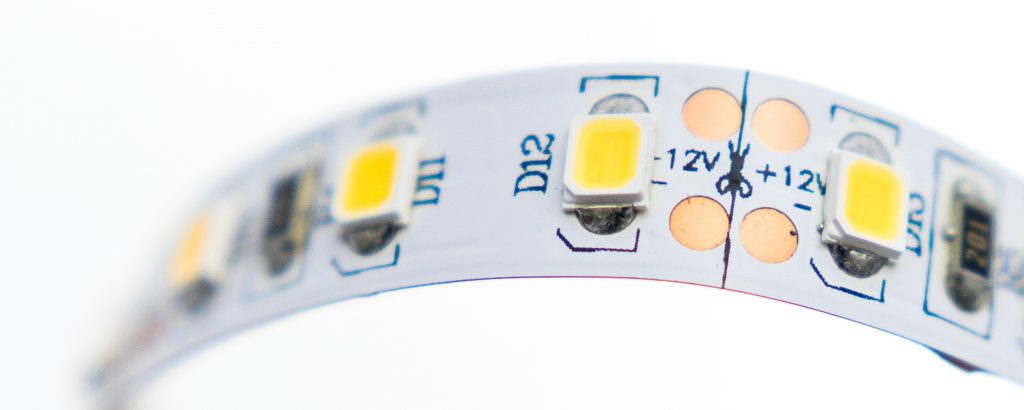
It’s essential to understand that different types of LEDs require various voltages and currents. For example, some high-power LEDs used for lighting applications may require currents up to several amperes, while others, like low-power indicator LEDs, may only need milliamperes.
A common characteristic among all these types lies in their vulnerability towards high-current damage. Hence, it’s crucial to use appropriate resistors or constant-current circuits with such lights not just for optimal functioning but also longevity.
Explanation on How LED Lights Work
Decoding the Luminous Language of Light-Emitting Diodes
LEDs are fascinating pieces of technology developed through years of scientific advancement. An LED operates under an effect known as ‘electroluminescence,’ which is essentially a characteristic feature of certain materials that enables them to emit light in response to an electric current or strong electric field passing through them.
At its heart lies a chip made from layers of semi-conductive material. The chip has two regions separated by a junction: the ‘p-type region’ having positive electric charge carriers (holes) and the ‘n-type region’ having negative electric charge carriers (electrons). When voltage is applied across these regions, electrons from the n-region begin to combine with holes in the p-region at the junction.
This process, known as recombination, leads to a drop in the energy levels of electrons. That excess energy then gets cast off as photons – particles of light. The color of this emitted light is determined by the specific semiconducting material used in chip fabrication and can range across a broad spectrum from infrared to ultraviolet.
Discussion on the Type of Current Used by LED Lights
Delineating the Direct Current Dominance in LEDs
The journey of understanding LED lights eventually brings us towards unriddling their preference for a direct current (DC). Given that LEDs are diodes – devices that allow electric current to flow only in one direction – it’s consistent that they operate on DC rather than alternating current (AC).
In an AC circuit, current keeps reversing its direction, causing an LED light to switch off during every alternate cycle when current flows in a non-preferred direction. This rapid on-off switching might lead to an undesirable flickering effect and a reduction in lifespan due to recurring thermal stress.
Furthermore, connecting an LED directly into an AC supply would result in not just inefficient operation but potential damage too, emanating from reverse-bias breakdowns or excessive peak currents. Therefore, LEDs usually come equipped with components that convert an AC supply into more suitable DC power.
However, there are certain LEDs designed for AC power supplies that incorporate special circuits for rectifying and smoothing out the input AC signal so as not to harm diodes’ performance or longevity. Despite such adaptations, though, the innate tendency and compatibility of LEDs remain oriented towards DC.
Why LEDs use Direct Current (DC)
The Attraction of LEDs to the Stability of DC
Light-emitting diodes, more commonly referred to as LEDs, exhibit a discernible predilection for direct current (DC) instead of alternating current (AC). The rationale behind this preferential treatment is deeply rooted in their inherent operational features.
LEDs, unlike standard incandescent bulbs, do not generate light by heating a filament. Instead, they produce light through a process known as electroluminescence – an optical and electrical phenomenon wherein a material emits light in response to an electric current or a strong electric field passed through it.

This process requires the flow of current in one unidirectional path to stimulate the release of photons – particles representing a quantum of light. This unidirectional flow characteristic is inherently present in DC and not AC.
Given that DC provides a consistent voltage level, it allows for LED lights to maintain constant brightness. Furthermore, utilizing DC minimizes potential flicker issues, which can occur if the diode isn’t sufficiently fast at responding to alterations with AC power supply levels.
The Science Behind LEDs’ Preference for DC
Unveiling the Quantum Phenomena Governing LED Operation
Delving into the scientific domain and explaining why LED lights favor direct current demands an understanding of basic principles governing semiconductor physics. At its core, an LED is fundamentally a semiconductor diode – essentially comprised of two layers of semiconductor material called p-type and n-type materials.
When voltage gets applied across these materials, electrons from the n-type layer start migrating towards the p-type layer. Concurrently, holes from the p-type layer move towards the n-type semiconductor layer. When these free electrons drop into holes during their passage across junctions between layers, they inflict energy states drop within atoms, causing them to dissipate surplus energy in the form of photons.
This intricate process, termed recombination, results in radiating light from the LED. Due to this operation manner, LED lights necessitate a unidirectional current flow provided by direct current. The current needs to be stable and reliable to allow for consistent light output; fluctuating voltage levels could result in an inconsistent and unstable light source.
Impact of Using AC on an LED Light’s Performance
Exploring the Consequences of AC Utilization in LEDs
Despite LEDs’ inherent preference for DC, it’s worth understanding what would transpire if one attempted to power these lights with alternating current (AC). Essentially, LEDs are not designed to handle the sinusoidal changes in voltage levels that characterize AC power supplies. Herein lies the crux of using AC for powering LEDs.
If subjected to an alternating current source, an LED will only conduct during positive half cycles when the terminal voltage is higher than its forward threshold voltage level. During negative half cycles, when reverse biasing occurs across the diode junction, no conduction takes place, effectively rendering it turned off.
Hence, continuous switching on and off happens at frequencies equaling twice that of the supplied frequency, leading to a flicker effect discernible, especially at lower frequencies. Moreover, incessant swings between high and low energy states could potentially inflict strain upon semiconductor junctions within LED configurations over time.
This can adversely affect their longevity by accelerating the wear and tear process, thereby truncating their overall lifespan. While it is technically feasible to power LEDs using AC, doing so without appropriate modifications or precautions may induce deleterious impacts on both their performance and durability.
Turning the Current: The Conversion of AC to DC for LEDs
The transition from alternating current (AC) to direct current (DC) is pivotal in the operation of LED lights. This conversion process, while seemingly arcane, is fundamentally crucial as it allows the LED lights to function optimally. Without this transition, LEDs would be subjected to rapid fluctuations in energy levels that could damage their internal components.
One might wonder about the devices used in this conversion process. At its core are rectifiers and drivers that autonomously perform this transformation.
A rectifier converts the AC into DC by allowing current flow in one direction only, thereby creating a unidirectional current that is preferred by LEDs. The conversion process may be imagined as a kind of power translation service for your LEDs; it interprets and transforms incoming alternating currents into a language – direct current – that your LED lights can understand and utilize efficiently.
The Multifaceted World of LED Lights: Power Requirements across Domains
Delving deeper into the world of LED lights, we discover a range encompassing household LEDs, industrial LEDs, and automotive LEDs. Each category has its own unique characteristics and power requirements determined by their functions and environments.
Household LEDs require lower power inputs as compared to their industrial counterparts because they are typically smaller and utilized for shorter periods. Industrial LEDs often operate under strenuous conditions over prolonged durations necessitating higher power inputs, while automotive LEDs require an intricate balance between brightness for visibility and minimal energy consumption considering vehicular battery limits.
Advantages and Disadvantages of Using DC for LED Lights
Utilizing DC for powering LED lights presents both benefits and drawbacks. On one hand, it offers high efficiency levels as there are no losses associated with energy fluctuations inherent with AC. Furthermore, using DC promotes an extended lifespan for your LED light due to less stress on the components.

However, a significant consideration lies in cost implications. The requisite technology for AC to DC conversion – the rectifiers and drivers – can be expensive. This can elevate the initial costs of LED light installation, but it is essential to consider the longer-term benefits in energy savings and durability.
Case Studies: AC vs DC for LED Lights in Different Settings
The discourse surrounding AC versus DC for LEDs extends into practical applications. In residential settings, using DC-powered LEDs offers energy efficiency and longevity despite higher upfront costs. Similarly, commercial settings benefit from these advantages, with the additional merit of requiring less maintenance than conventional lighting options.
Industrial settings present a dynamic scenario due to the heavy-duty nature of operations. Here, DC-powered LEDs outshine their AC counterparts due to their superior endurance and stability under demanding conditions.
Looking Towards Tomorrow: Future Trends in Powering LED Lights
As we cast our eyes towards emerging trends, there are promising prospects towards further enhancing how we power LED lights. Innovations in power conversion technologies are striving for even more efficient processes with potential reductions in associated costs.
One can also witness an evolution towards more energy-efficient solutions as global sustainability continues to rise in our collective consciousness. This might lead us towards novel options – perhaps solar or wind-generated direct current sources that could offer renewable solutions for powering LED lights.
Conclusion: Do LED Lights Require AC or DC?
While LED lights prefer direct current (DC), they are often initially met with alternating current (AC). It’s through our understanding of this process that we truly recognize its indispensability – a beautiful dance between science and technology resulting in bright ideas that light up our world. The importance of understanding these power requirements cannot be understated when using or installing LED lights, as it helps ensure optimal performance whilst saving both energy and cost over time.
You may also be interested in the following posts: