
LED Landscape Lights: Do They Need Special Transformers?
The Luminous World of LED Landscape Lights
LED landscape lights have revolutionized outdoor lighting aesthetics, casting enchanting lights that breathe life into the nocturnal panorama of our gardens, patios, walkways, and other outdoor spaces. In essence, LED (light-emitting diode) landscape lights are small yet robust lighting fixtures designed specifically to withstand external weather conditions while providing effective and efficient outdoor lighting.
These luminaires are celebrated for their energy efficiency and longevity. Characterized by their low-voltage operation, they consume significantly less electricity than traditional incandescent or halogen bulbs. Also, the durability of LEDs is unparalleled; they can burn brightly for up to 50,000 hours. This superior lifespan, combined with their energy-saving attributes, makes them an ideal choice for many homeowners and landscapers alike.
However, it’s not just practicality that these lights offer; LED landscape lighting also enables creative freedom. Available in a myriad of designs, from path lights to spotlights and even underwater fixtures, these versatile illuminators enhance architectural details while fostering an inviting ambiance around your property.
But like any form of lighting technology, LEDs come with their own specific requirements. Understanding these intricacies can help you maximize your outdoor lighting experience while ensuring the safety and longevity of your setup.
It’s worth highlighting that despite their numerous advantages over their traditional counterparts, such as reduced energy costs and longer lifespans, installing LED landscape lights is more than just replacing old bulbs with new ones. They require careful planning around power needs and compatibility issues.
The Crucial Role of Transformers in Lighting Systems
To comprehend why special transformers might be needed for LED landscape lights or any light fixture at all for that matter, we must first grapple with what a transformer is and its core function within a lighting system. In its most rudimentary form, a transformer is a device used to either step up or step down the voltage of electricity. This function is crucial in various electrical appliances, from your laptop charger to, indeed, your outdoor lighting system.
In the realm of landscape lighting, low-voltage transformers are typically employed. These devices convert the standard 120-volt household current into a safer 12 or 24 volts, reducing the risk of electrical shock in damp environments such as gardens and other outdoor spaces.

Transformers are not mere functional entities but integral components that influence both the performance and lifespan of your lights. They ensure that your LED landscape lighting system receives precisely the right amount of electricity needed to operate efficiently without overloading or damaging the fixtures.
Moreover, transformers can be outfitted with timers and photocells, allowing for automation capabilities. This means you can program them to switch on at dusk and off at dawn or schedule them according to your specific needs, adding another layer of convenience to their utility.
Understanding why a transformer is indispensable for safe and efficient operation lays a firm foundation for delving deeper into whether special transformers are required for LED landscape lights and, if so, how one might identify an optimal choice amongst available options. With this groundwork established, we can now delve into the heart of our topic with clarity.
Understanding LED Landscape Lights
An Introduction to LED Landscape Lighting
Light-emitting diodes, more colloquially known as LEDs, have become inveterate luminaries in the realm of landscape lighting. Their inherent functionality lies in their ability to emit light when an electrical current is passed through them.
Crafting an idyllic ambience, LED landscape lights artistically illuminate outdoor spaces like gardens and patios while simultaneously accentuating architectural features. LEDs are semiconductor devices that convert electricity into light by the principle of electroluminescence.
Unlike conventional incandescent or halogen bulbs that generate heat along with light, LEDs produce directional light, making them a more efficient choice for landscape lighting. Additionally, LEDs have a longer lifespan, often exceeding 50,000 hours, which significantly reduces replacement frequency.
Commendable Benefits of LED Landscape Lights
A remarkable and salient feature of LED landscape lights is their energy efficiency. LEDs consume up to 80% less power than traditional lighting solutions while offering the same level of brightness. This contributes not just to lower electricity costs but also aids in reducing the carbon footprint. Another noteworthy attribute is their durability and resilience against harsh weather conditions and temperature fluctuations, making them a preferential choice for outdoor applications like landscape lighting.
LEDs are also acclaimed for their color versatility, providing ample options for customization as per individual preferences or specific design requirements. Furthermore, with advancements in technology, many modern LED fixtures come equipped with dimming capabilities and control systems, allowing users greater command over illumination levels, thus enhancing functionality and the user experience.
Drawbacks: The Other Side of the Spectrum
Despite all its luminary advantages, it would be remiss not to mention certain drawbacks associated with LED landscape lights. First amongst these pertains to initial costs; although operational costs over time are lower due to reduced energy consumption and longevity, the upfront cost of LEDs is generally higher than traditional lighting fixtures.
Additionally, not all LEDs are created equal. Quality and performance may vary significantly between manufacturers, and inferior products may fail prematurely or display inconsistent light quality. Therefore, while choosing LED landscape lights, it’s essential to consider the brand reputation and reviews.
Although rare, LEDs can be susceptible to voltage fluctuations, which might affect their performance. Therefore, the use of proper transformers becomes imperative in maintaining optimal functionality – a topic we delve deeper into in subsequent sections.
The Role of Transformers in Lighting Systems
Delineating the Functionality of a Transformer
A transformer, in the context of electrical engineering, is an underlying device that plays a pivotal role in our daily lighting needs. Akin to an indefatigable sentinel, it works behind the scenes to transmute voltage levels according to the specific requirements of your lighting fixtures. Essentially, it has two primary tasks: stepping up or increasing voltage and stepping down or decreasing voltage.
The principle at its core is magnetic induction – a centuries-old discovery by pioneering scientist Michael Faraday. The transformer comprises two coils, primary and secondary, wrapped around a ferromagnetic core. When alternating current passes through the primary coil, it establishes a fluctuating magnetic field around the core. This field then induces an electromotive force (EMF) in the secondary coil.
The transformation ratio – that is, the amplification or reduction in voltage – depends on the number of turns in each coil. If there are more turns on the secondary side (as compared to the primary), voltage steps up. Conversely, if there are fewer turns on the secondary side, voltage steps down. This ability to alter voltages renders transformers indispensable for many lighting systems as they ensure safe and efficient power delivery from sources (like your home’s main electrical supply) to various devices (like your landscape lights).
Exploring Different Types of Transformers and Their Uses
Categoryically speaking, there exists a pantheon of transformers tailored for diverse applications across industrial domains; however, within household lighting systems, including landscape lighting, two types warrant particular mention: magnetic transformers and electronic transformers.
Magnetic transformers – also known as iron-core or conventional transformers – are stalwarts that have been used reliably for decades. They function best with low-voltage halogen bulbs but can also work with LED lights under certain conditions, which will be discussed later. Their robust construction and high power capacity make them ideal for larger, long-lasting lighting installations. However, their size and weight could be a limiting factor in specific scenarios.
Contrastingly, electronic transformers are predominantly employed with modern lighting technology, such as LEDs. They operate at a higher frequency compared to their magnetic counterparts, resulting in a compact design and reduced weight. They offer excellent compatibility with low-voltage LED lights; however, they do exhibit limitations concerning minimum load requirements and potential issues with dimmer compatibility.

In essence, the type of transformer you select should align with: the specification of your lights (halogen or LED type; low or line voltage), the scope of your installation (a few patio lights or an expansive garden), and factors such as durability, cost-effectiveness, and energy efficiency, amongst others.
Recognizing the role of transformers in lighting systems is crucial to understanding their significance not only as regulatory devices but also as key components ensuring the longevity and performance of your lighting fixtures. Whether it’s magnetic or electronic will hinge upon multiple factors, but rest assured – once you grasp these underlying concepts, you’ll be lighting your landscape optimally.
Requirement for Special Transformers in LED Landscape Lights
Necessity of Distinctive Transformers for LED Lighting Systems
LED landscape lights, due to their unique architecture and operational requirements, often necessitate the use of special transformers. These transformers are designed to accommodate specific voltage and wattage requirements of LEDs, thereby ensuring their efficient operation and extended lifespan.
The principal reason behind these distinctive requirements lies in the inherent functionality of LEDs. Unlike traditional incandescent or halogen lights, which operate on higher voltage levels (typically around 120 volts), most LED lights are low-voltage devices that normally function between 12 and 24 volts.
Therefore, a transformer is required to step down the high-voltage supply into a more suitable lower level compatible with LEDs. Moreover, while incandescent bulbs can handle slight fluctuations in voltage without significant impact on performance or lifespan, LEDs are far more sensitive.
Even minor deviations from the optimal voltage can result in decreased brightness intensity or potential damage to the light’s internal components. Hence, special transformers designed for LEDs often incorporate additional circuitry that provides stable and precise voltage outputs.
Deciphering Influential Determinants: Voltage and Wattage
A series of factors influence whether a particular type of transformer will be compatible with an LED landscape lighting system. Two crucial determinants among them are undeniably voltage and wattage.
Voltage is an electric force that pushes electric current through a wire. In simpler terms, it can be thought of as electrical pressure. For an LED landscape light to function optimally without straining its components or reducing its lifespan, it must receive correct pressure – neither too high nor too low – from its power source, thus underscoring the importance of having a transformer that furnishes appropriate voltage.
Wattage signifies power consumption rate or energy usage per unit time. It’s crucial because every transformer has a maximum load capacity, measured in watts, it can handle. For efficient and safe operation of the LED lighting system, the total wattage of all lights should be within 80% of the transformer’s maximum capacity to avoid overloading.
Importance of Voltage and Wattage: The Underlying Science
Understanding voltage and wattage is not merely an exercise in electrical jargon but a fundamental necessity when exploring the requirement for special transformers in LED landscape lighting. LEDs operate on direct current (DC), unlike traditional bulbs, which use alternating current (AC). A transformer, therefore, plays a dual role: it not only steps down AC voltage to lower levels but also rectifies AC into DC suitable for LED operations.
LEDs are current-driven devices, meaning their brightness is controlled by the amount of flowing electric current. Current is directly linked with voltage, as per Ohm’s law, stating that current equals voltage divided by resistance. Hence, any fluctuation in supply voltage can alter LED brightness or even lead to its failure.
Wattage too has an impact on transformer selection. A higher wattage signifies greater energy consumption, which can cause increased heat generation, potentially impacting LED performance or lifespan adversely. Both voltage and wattage dynamics have a significant bearing on whether special transformers are required for LED landscape lights, making them crucial aspects to consider while designing or upgrading your luminous outdoor sanctuary.
Types of Transformers Suitable for LED Landscape Lights
Magnetic Transformers
Journeying into the realm of transformers, one encounters two primary categories, with magnetic transformers being one. Magnetic transformers are often described as the more traditional or ‘old school’ type of transformer.
Functionality-wise, they operate on the principles of electromagnetic induction. They consist of two coils, a primary and a secondary coil, that share a magnetic core. The voltage change occurs when an electrical current passes through these coils.

Magnetic transformers do have their merits when used with LEDs. They are renowned for their durability, robustness, and ability to handle higher loads – qualities that may be essential if you possess an extensive landscape lighting array. Moreover, they provide a clean power output, which maintains the longevity of your LED lights.
However, these behemoths come with their challenges. The most prominent are compatibility issues with LED lights due to minimum load requirements. If your lighting system does not meet this requirement, flickering or premature bulb failure may occur.
Electronic Transformers
The second contender in our transformer showdown is the electronic transformer, a modern solution for an evolving world of technology. Electronic transformers function using electronic oscillator circuits, which convert input voltage to high-frequency alternating currents before it’s reduced to a safer output level. Electronic transformers bring many advantages to the fore when used with LEDs, chief among them being lighter and more compact than their magnetic counterparts; they offer greater flexibility during installation.
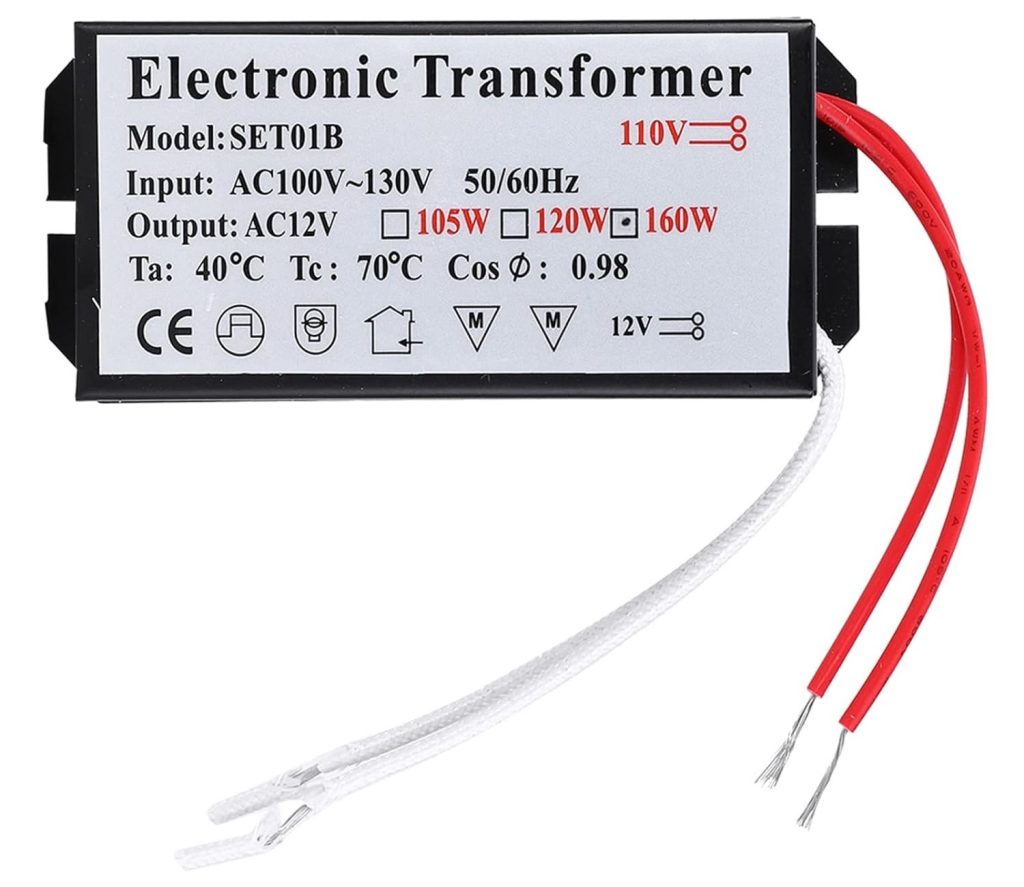
Additionally, there is no minimum load requirement issue, which makes them ideal for small LED installations. Nevertheless, electronic transformers aren’t without flaws; they can produce an unstable power supply, which may lead to flickering and may not be suitable for large-scale outdoor lighting due to lower wattage capabilities.
How to Choose the Right Transformer for your LED Landscape Lights
Choosing the right transformer for your LED landscape lights is essential to maintaining a harmonious and efficient lighting system. Several parameters should be taken into consideration: power requirements, the total number of fixtures you plan to use, and the voltage of your LED lights.
Firstly, calculate the total power requirement of your lighting setup. This is done by multiplying the wattage of each light fixture with their respective quantities. Once you have this cumulative wattage figure, select a transformer that can handle at least 1.25 times this amount.
Secondly, consider whether your setup is small-scale or extensive; if it’s the latter, magnetic transformers may be a better fit due to their ability to handle higher loads. Ensure that your chosen transformer’s output voltage matches that of your LED lights for optimal performance and longevity.
Installation Process for Transformers in LED Landscape Lighting Systems
Safety during installation is paramount; always remember to switch off all power sources before starting any work with electrical equipment. Additionally, wearing rubber gloves provides an extra layer of protection from accidental shocks.
Installation usually begins with mounting the transformer near a GFCI-protected outdoor electrical outlet, followed by connecting cables from the light fixtures to the transformer. Once everything is connected and mounted correctly, switch on the power source and adjust timing settings according to personal preferences or needs.
Common Problems and Solutions with Transformers in LED Landscape Lights
With any electrical system comes potential issues, and LED landscape lighting is no exception. One common issue arises from improper loading: when LEDs don’t meet minimum load requirements, they may flicker or fail prematurely.
Another issue could emanate from having too many LEDs for one transformer, causing it to overload and potentially fail. Practical solutions include ensuring proper loading by choosing compatible transformers (such as electronic transformers, which have no minimum load) or by dividing large LED setups between multiple transformers to prevent overloading.
Conclusion: Do LED Landscape Lights Require a Special Transformer?
In our quest to understand whether LED landscape lights require a special transformer, we’ve delved deep into the world of transformers and became knowledgeable. Our journey has enlightened us that choosing the correct transformer is not merely about special or not, but more about understanding your specific lighting needs and matching them with the right type of transformer, be it magnetic or electronic.
Endeavoring into the realm of LED landscape lighting can initially seem daunting, but remember that every shadow is proof of light. So let’s cast aside trepidation, embrace the light, and step confidently forward into a brighter tomorrow.
You may also be interested in the following posts: