
Cracking the Enigma: Why Do String Lights Blow Fuses?
The Luminary Essence of String Lights
String lights, often referred to as fairy lights or landscape string lights, are delightful features that vivify the ambiance of any setting with their gentle luminescence. These enchanting light forms are small and typically set in a series or parallel configuration on a long wire.
They are distinguished by their flexibility and versatility, making them a popular choice for various decorative purposes. Their applications are incredibly diverse, ranging from everyday domestic use to festive decorations or professional landscape lighting.
Landscape lighting with string lights helps create an ethereal aura that instantly beautifies the area while providing essential illumination. Their twinkling glow renders an enchanting spectacle during evening garden parties, weddings, or even within the cozy confines of one’s room.
Additionally, they work great for accentuating architectural details or garden features while also improving overall outdoor safety and security at night. From draping them over trees for whimsical outdoor gatherings to adorning your patio for an inviting barbeque evening, string lights infuse charm wherever they twinkle.
A Glowing Issue: Frequent Fuse Blowouts in String Lights
Despite the aesthetic appeal string lights offer, particularly for landscape lighting purposes, there is one issue that users often encounter – frequent blowing of fuses. This seemingly inconspicuous problem does not just lead to abrupt disruption in lighting but also demands recurrent replacement costs, which can be quite inconvenient.
A fuse is essentially a critical safety device in any electrical gadget – including your beloved string lights. It acts as the guardian angel that sacrifices itself to protect the circuitry when something goes awry with the electricity flow; it blows out so your circuit doesn’t have to bear excess current load that could potentially lead to more severe damages like electrical fires.
When you find your landscape string light fuses blowing repeatedly without any apparent reason such as overloading or power surges, it’s time for some serious troubleshooting. This repetitive problem might signify underlying issues that need immediate attention lest they cause long-term damage to not just your string lights but potentially other electrical systems in your vicinity as well.
Understanding these underlying issues requires a rudimentary grasp of how electricity works, especially within the context of string lights, and how fuses serve their protective function. It’s crucial to acknowledge here that while string lights are alluringly simple in their appearance and application, the electric principles they operate on are complex, which underscores the importance of handling them with informed caution.
In the sections to follow, we will delve into explaining these basics and then unravel the common causes that lead to frequent fuse blowouts in string lights. We’ll also provide preventive measures to minimize such occurrences and extend the durability of your landscape lighting setup.
Demystifying the Essence of a Fuse
Unveiling the Secret Life of Fuses
A fuse, in its simplest terms, acts as a guardian angel to any electrical circuit. It is a tiny safety device that plays an indispensable role in preventing excessive flow of current, thereby forestalling potential damage and hazardous scenarios. Comprising a metal wire or strip that melts when too much current flows through it, the fuse interrupts the circuit and halts the surge of electricity.
Fuses ubiquitously exist within several everyday appliances and gadgets, landscape string lights included. They are an integral part of landscape lighting fixtures, and their function cannot be overemphasized. When the amount of current surpasses what’s recommended for safe operation, the fuse dutifully steps in to cut off electricity flow.
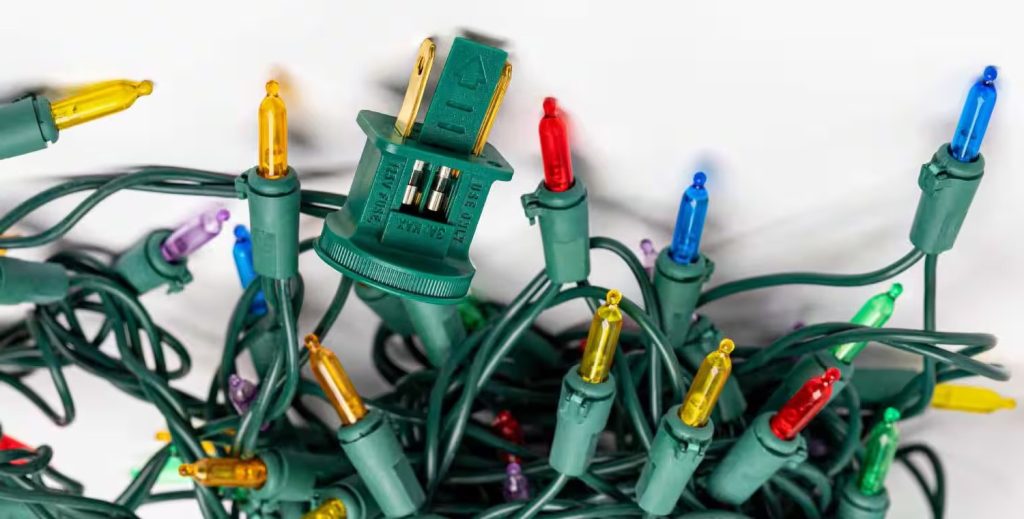
The functioning principle behind fuses is quite straightforward yet ingenious – they make use of the heat generated by electrical resistance. When electric current courses through a wire, it faces some resistance, which generates heat.
In an overloaded situation, as more electricity tries to squeeze through than what’s safe for the wire to carry, excess heat is generated, which causes the metal alloy in the fuse to melt, thus breaking off the power supply.
It’s pivotal to understand that each fuse is designed for specific ratings and applications depending on voltage requirements and other parameters. The ratings dictate how much current can safely pass before it ‘sacrifices’ itself (melts) for circuit protection.
These specifications need to be meticulously adhered to when replacing fuses. In essence, fuses act as sacrificial lambs within electrical circuits. By melting under excessive currents, they prevent overheating, which could potentially cause fires or damage equipment, including string lights used as landscape lighting.
The Wonders of String Lights: A Journey through Electrified Lighting
The Electric Orchestra: How String Lights Work
String lights, often an essential part of landscape lighting, are a wonderful creation that add a sprinkle of magic to any scenery. But how do these radiant beauties function?
Their operation revolves around the principles of electricity and simple circuitry. Each individual bulb in a string light is part of a long series circuit that is connected via wiring. When you plug in the string lights, an electrical pathway is created from the power source through each light bulb and back again. This closed path allows for the smooth flow of electrons that ultimately results in illumination.
The functionality of string lights isn’t limited merely to lighting up bulbs. Within this seemingly simple solution lies complexity – each bulb has its own shunt wire. A shunt wire is a secondary circuit within each bulb that ensures continuity in case the main filament fails.
This feature prevents failure of one bulb from turning off your entire landscape lighting set-up. The passage of electricity through these lights isn’t unregulated, though. That’s where our previously discussed fuse steps into play, safeguarding against potential overloads or short-circuits that could turn your magical landscape string lights into calamitous fire starters.
Understanding how string lights work underscores their elegance beyond superficial radiance; it’s a symphony orchestrated by electricity itself, guided by safety measures like fuses acting as vigilant conductors ensuring harmonious performance with every flicker.
Causes for String Lights Blowing Fuses: Exposing the Invisible Culprits
Overloading the Circuit: A Bright Idea Gone Wrong
When it comes to landscape string lights, as breathtaking as they may be, moderation is key. Overloading the circuit by connecting too many lights on one fuse is a common pitfall. The principle of overloading is rather straightforward – each fuse in your string light set has a specific current rating (usually denoted in amps). When that current is exceeded, the fuse blows to protect your circuit.
Visualize this overloading as a footrace where each runner represents an electric charge and the track symbolizes your string light circuit. If too many runners are forced onto a single track simultaneously, chaos ensues, resulting in collisions and trippings – or in electrical terms – an overload causing blown fuses.
Examples of such scenarios are plentiful during festive seasons or grand celebrations when we ambitiously embellish our landscapes with an infinite sea of twinkling lights. Without realizing it, we might be pushing our circuits beyond their capacity by attaching numerous landscape lighting strings together – an electrical faux pas leading to blown fuses.
Short Circuits: An Unseen Saboteur
Another unseen saboteur causing fuses to blow in your landscape string lights could be short circuits. A short circuit occurs when electricity finds a shorter pathway to ground than its intended route – akin to water finding the path of least resistance.
This causes a sudden surge of electricity that can overwhelm and blow out fuses quickly. Short circuits can be caused by various factors like frayed wires, defective equipment, or even environmental elements such as moisture intrusion, which is common in outdoor settings like landscape lighting setups.
The effect of short circuits on string lights can vary from mild disruptions like intermittent functioning or decreased brightness levels to serious consequences like blowing out multiple fuses simultaneously or even causing a fire hazard. Hence, regular inspection and maintenance of wiring in landscape string lights are crucial to prevent these miniature electrical mishaps from escalating into significant safety risks.
Faulty or Old Fuses: The Silent Victims of Time
The lifespan and wear-and-tear of fuses play a significant role in maintaining the health of your landscape string lights. Think of a fuse as the unsung hero of your lighting setup. Its purpose is to take one for the team – sacrificing itself to ensure that an electrical anomaly doesn’t damage the entire system.
A typical fuse, subjected to normal conditions and use, may last several years, but factors such as repeated overloads, short circuits, and even cyclic on-off operations can significantly reduce its lifespan, leading to premature failure. It’s also important to recognize signs that a fuse is old or faulty.
While it might be challenging to visually identify an aging fuse without removing it from the circuit, there are other symptoms you could look out for; these include recurrent blown fuses despite correction measures or unexplained malfunctioning of segments within your landscape lighting setup. Remember, when in doubt about an old or weak fuse, replacing it might be safer than enduring unforeseen lighting disruptions during your prized events.
Preventing Fuse Blowouts in String Lights
Avoiding Circuit Overload with Thoughtful Use of String Lights
To circumvent the issue of overloading, it is imperative to deploy string lights judiciously. The number of strings connected should be within safe limits; the general rule of thumb is not to exceed three standard-size sets of string lights together. This limit helps prevent overloading and, consequently, fuse blowouts.
The landscape can be lit beautifully by strategically placing landscape lighting rather than indiscriminately connecting numerous strings together. A well-placed single string light often contributes more to the aesthetics than multiple haphazardly connected ones.
The wattage plays a significant role in circuit loading. It’s crucial to determine the total wattage of your landscape string lights configuration before installation to ensure you don’t end up overloading the fuse with superfluous energy demands. A rudimentary understanding of how wattage translates into power requirements can be quite beneficial in this regard.
Remember, restraint and planning are key when it comes to using string lights effectively without risking circuit overload. An awareness of each light set’s power consumption and wisely limiting connections can help prolong fuse life while maintaining an enchanting lighting for your landscapes.
Mitigating Wiring Issues: Key to Preventing Short Circuits
Short circuits are another common nemesis for fuses, often triggered by compromised wiring in your string lights setup.
Regular maintenance checks are thus a necessity if one hopes to fend off unwanted short circuits that lead inevitably towards blown fuses. These checks should involve scrutiny for frayed wires, crushed insulation, or any other visible signs of damage that could potentially cause a short circuit.
For outdoor setups like landscape lighting or landscape string lights, additional factors like weather damage must also be considered during these inspections.
Equally important are proper handling and storage methods for your string lights when they are not in use. Carelessness during handling can often lead to damage in the thin wires, resulting in short circuits. When storing, ensure the lights are kept in a dry location free from extreme temperature fluctuations.
Even with perfect maintenance routines, it’s prudent to bear in mind that wear and tear over time will inevitably take its toll on your string lights’ wiring. Preemptive measures and routine check-ups can, however, significantly extend the lifespan of your setup.
Replacing Old or Faulty Fuses: An Essential Task
Fuses, like any other component of a lighting system, have a limited lifespan and will eventually require replacement. An old fuse is more likely to blow as it may not be able to handle power surges or minor overloads anymore.
To maintain an efficiently functioning string lights assembly, one should ideally replace fuses at least once every season. This ensures that all components are robust and capable of withstanding regular energy demands without succumbing prematurely.
Replacing a blown fuse is a straightforward task that requires little more than a replacement fuse and a few minutes of your time. Begin by identifying the blown fuse – usually seen as having a blackened or unclear glass window compared to others.
After ensuring your string light is unplugged from any power source, locate the small door on the plug that holds the fuses – this typically slides open easily with gentle pressure applied using something like a small flathead screwdriver.
Once opened, gently remove the blown fuse and replace it with a new one of identical rating (as indicated by color). Close back up the holder, ensuring it clicks into place securely before plugging back into power for testing.
By maintaining vigilance over these three aspects – avoiding circuit overload through thoughtful usage of string lights, mitigating wiring issues through regular checks, and timely replacing old or faulty fuses – you can ensure a longer life for your landscape lighting setup with minimal incidence of blown fuses.
Case Study: Common Scenarios & Solutions
The Outdoor Event Conundrum
At an outdoor event, landscape string lights were used extensively to create an enchanting ambiance. However, the lights kept blowing fuses. On investigating, it was found that multiple strings were connected end-to-end without considering their overall wattage. This overloading caused the fuses to blow frequently. By simply spreading out the strings and connecting them to separate circuits or outlets, the issue was resolved.
Night Market Nuisance
In another scenario at a bustling night market, vendors used string lights for their stalls but experienced frequent fuse blowouts. The culprit was short circuits due to haphazard wiring and contact with moisture. To keep their versatile landscape lighting operational, they had to ensure proper insulation of wires and connections.
Residential Dilemma
A residential holiday display faced a similar issue with their landscape string lights constantly blowing fuses. Upon inspection, it turned out that the fuses were old and worn out – a common occurrence in households where decorations are reused year after year without much maintenance. Simply replacing these outdated fuses with new ones addressed the problem.
Conclusion: Why Do String Lights Keep Blowing Fuses?
The complexities of electrical circuits can lead to some perplexing scenarios when using string lights – especially in outdoor settings like landscape lighting, where elements like moisture or overloading can come into play. However, by understanding basic electrical principles such as not overloading circuits and ensuring well-maintained equipment, we can prevent our festive lights from darkening unexpectedly.
So whether it’s for an outdoor event, a vibrant night market stall, or your own residential display, keeping those twinkling landscape string lights glowing brightly is indeed achievable! It’s all about smart planning, regular checks for potential issues, and timely interventions when required.
You may also be interested in the following posts: