
The Luminous Revolution: An Insight into LED Strip Lights
Enter the world of LED strip lights, a versatile and efficient lighting solution that’s revolutionizing both home and commercial environments. These strips, as their name suggests, are long, flexible bands populated with tiny light-emitting diodes (LEDs) spaced at regular intervals. Emitting bright but energy-efficient light, they offer unparalleled adaptability to various applications.
From enhancing architectural details to mood-setting ambient lighting in homes or businesses or even providing practical lighting in hard-to-reach areas, these innovative lights are making a significant impact. LED strip lights provide an aesthetic appeal and versatility that’s challenging the traditional incandescent and fluorescent bulbs.
Their slim profile allows them to be tucked away under kitchen cabinets or bookshelves, wrapped around mirrors or artworks, or even used as landscape strip lights for garden paths or outdoor structures. It’s this ceaseless ability to blend functionality with aesthetics that makes LED strip lights such an attractive proposition.
A Beacon in the Modern World: The Importance of LED Strip Lights
As we navigate through the 21st century, it’s clear that our consumption patterns have vastly evolved over time – we are now more aware of the environmental implications of our choices and value sustainable solutions more than ever before.
This shift is evident in the lighting industry too, where there has been a considerable move towards energy-efficient options such as LEDs. Among these, LED strip lights occupy an essential position due to their sheer versatility and efficiency.
Given today’s architectural trends, which often demand flexibility in lighting solutions – from highlighting contours of bespoke furniture to illuminating landscapes with tasteful subtlety – it’s hard not to feel awed by the broad scope offered by LED strip lights. These flexible strips can effortlessly adhere to any surface – flat or curved – allowing them to fit into spaces and applications where traditional lighting fails.
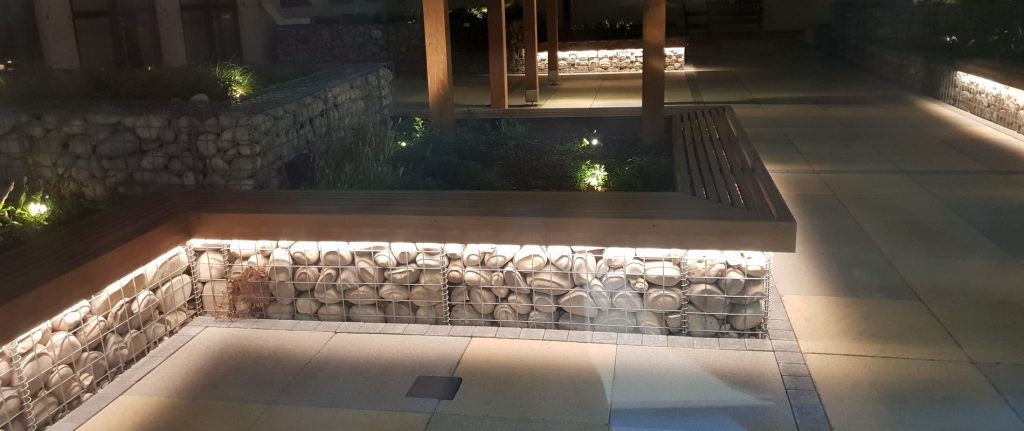
In commercial settings, businesses are leveraging the potential of LED strip lights to enhance their brand image. Whether it’s displaying signboards, creating mood lighting in restaurants and hotels, or accentuating product displays in retail outlets, the implementation of LED strip lights has made a significant contribution to establishing memorable customer experiences.
Furthermore, the emergence of smart homes has necessitated the need for adaptable lighting solutions. Here too, LED strip lights prove their mettle by integrating seamlessly with smart home systems for automatic controls and even color-changing abilities.
LED strip lights are not merely an optional aesthetic element but an essential component in today’s lighting solutions. They offer a harmonious blend of energy efficiency, versatility, and aesthetics that caters well to our evolving needs as well as environmental responsibilities.
Understanding LED Strip Lights
Delving into the World of Light-Emitting Diodes (LEDs)
LED, an acronym for light-emitting diodes, represents a significant shift in lighting technology. Unlike traditional light bulbs that employ electrical resistance to create light, LEDs use the movement of electrons across a semiconductor to produce light.
This process eliminates the need for heated filaments or gas reactions, resulting in highly efficient light sources that generate minimal heat. The inherent power efficiency of LEDs is complemented by their exceptional durability and lifespan.
Where traditional incandescent bulbs may last approximately 1,000 hours and compact fluorescent lights around 8,000 hours, LED lights can work effectively for up to 50,000 hours. This longevity significantly decreases the amount of waste generated by replacement lights.
Moreover, given their solid-state nature and small size, LEDs offer an unparalleled degree of design flexibility. They can be engineered into an array of shapes and sizes – from tiny indicators on electronic devices to large outdoor displays – which makes them extremely versatile across various applications.
Decoding How LED Strip Lights Work
LED strip lights are essentially a linear arrangement of multiple LEDs mounted on a flexible or rigid strip. These strips can be cut into specific lengths as per individual requirements and reconnected using connectors or soldering.
A typical LED strip light includes three main components: the LED emitters themselves, an adhesive backing for easy installation, and flexible circuitry to connect the emitters. The circuit board is usually encased in silicone or plastic for protection against environmental factors like moisture.
Although they require a DC power supply due to their low operational voltage (typically between 5V and 24V), most LED strips come with a plug-and-play setup that includes an AC adaptor. For larger installations such as landscape strip lights or other forms of landscape lighting where long lengths are utilized, a power supply with higher wattage may be necessary.
Exploring the Varieties of LED Strip Lights
LED strip lights come in a plethora of types, each having its unique characteristics and uses. For instance, there are single-color LED strips that emit just one color of light, whether warm white for cozy living spaces or cool white for task-oriented areas. Some versions even offer adjustable brightness levels.
On the other hand, RGB (red-green-blue) LED strips can produce multiple color hues by varying the intensity of the individual red, green, and blue LEDs. More advanced RGBW (red-green-blue-white) strips add a pure white light to the mix for more nuanced lighting effects.
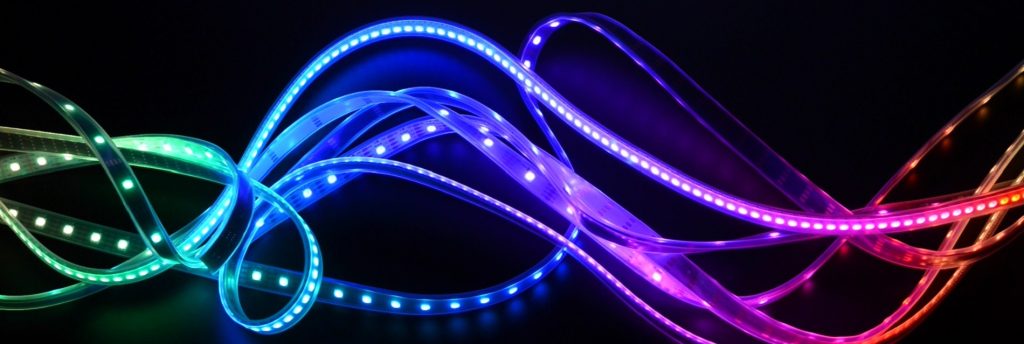
For more specialized applications like landscape strip lights or architectural installations requiring high brightness levels and superior color rendering, professional-grade high-density strip lights with closely spaced LEDs are preferred.
There’s also the option of waterproof LED strip lights for outdoor use or damp locations like bathrooms and kitchens. These carry an ingress protection (IP) rating that specifies their resistance level against dust and water.
Landscape Strip Lights: A Whole New World
Landscape lighting has become incredibly popular in recent years as homeowners seek to enhance their property’s aesthetics while improving safety. Here is where landscape strip lights show their true versatility.
Considered an innovative solution in landscape lighting, these flexible LEDs can be shaped around curved pathways, installed under stair treads for safety lighting, or even used to highlight special garden features like statues or water bodies. With weather-resistant constructions and ample brightness levels, landscape strip lights provide sleek yet powerful lighting that enhances any outdoor setting’s beauty.
Diverse Uses: Beyond Landscape Lighting
Apart from landscape lighting, LED strip lights find numerous other applications. They are often used as under-cabinet lighting in kitchens or task lighting in workspaces due to their slim profile and extensive light output. In commercial settings, they are ideal for creating eye-catching display cases or signage.
Moreover, in the realm of interior design, LED strip lights have emerged as a popular choice for accent lighting. Their ability to add a dramatic effect or highlight certain architectural features has made them a favorite among designers and homeowners alike.
With advancements in technology and increased accessibility, the possibilities with LED strip lights are vast and continually expanding. Whether it’s landscape lighting or creating a cozy ambiance in your living room, these versatile lights offer limitless potential to illuminate our surroundings.
Advantages of Using LED Strip Lights: A Bright Future
When it comes to landscape lighting, LED strip lights are a prominent choice due to their numerous advantages.
The first notable benefit is their energy efficiency. Unlike traditional incandescent bulbs or fluorescent lamps that waste most of their energy as heat, LEDs utilize nearly all the electricity they consume to produce light, resulting in a significantly lower energy consumption.
This energy efficiency not only reduces utility bills but also has undeniable long-term cost benefits. Over time, the investment in LED strip lights pays for itself due to their extended lifespan and decreased maintenance and replacement costs.
In terms of durability and longevity, LED strip lights triumph over other light sources by a wide margin. Their impressive lifespan can last up to 50,000 hours or more depending on usage, which is significantly longer than incandescent bulbs or halogen lamps.
This robustness extends beyond just time – LEDs are resistant against environmental factors like temperature changes and shock, making them perfect for outdoor landscape lighting applications.
Versatility and Flexibility: Light Up Your Vision
LED strip lights aren’t just for practical purposes; they’re also remarkably versatile, offering endless possibilities for both functional and aesthetic applications. They can be used anywhere from residential homes to commercial establishments, creating dramatic effects with vibrant colors or adding a subtle glow for emphasis.
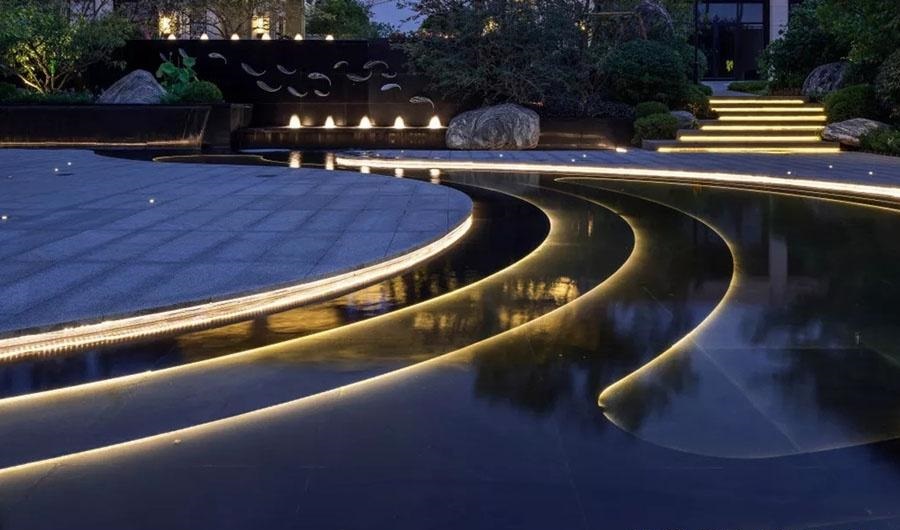
They are easily adaptable to different spaces due to their convenient form factor that can be custom cut and reconnected based on specific needs. This adaptability means you can let your creativity run wild when planning your landscape strip lights design – you’re not bound by rigid fixtures any longer!
In Harmony with the Environment: Eco-Friendly Lighting
LEDs have made landscape lighting environmentally friendly thanks to three key reasons. Firstly, their higher energy efficiency translates into a lower carbon footprint compared to conventional lighting methods. Secondly, reduced waste comes as part of the package, resulting from their significantly longer lifespan. Unlike some traditional lighting systems that contain mercury, LEDs are free from harmful chemicals or elements, making them a sustainable option.
Safety Aspects: A Brighter Light on Safety
The high safety rating of LED strip lights promotes peace of mind. Their lower heat emissions compared to traditional light sources mean they’re less likely to cause burns or fires even when left on for extended periods – an important consideration for landscape lighting. This reduced risk, coupled with their innate durability, makes them a safe choice for both indoor and outdoor lighting.
Creative Uses: Lighting Up Your Imagination
LED strip lights open up a world of creative possibilities. From under-cabinet lighting in kitchens to stairway lighting at home and signages or display cases in commercial settings, there’s hardly any area they can’t transform into something vibrant and welcoming.
What You Need to Know Before Purchasing LED Strip Lights
However, several factors must be taken into consideration before investing in LED strip lights. The quality and reliability of the product should be checked – not all LEDs are created equal.
Understanding warm versus cool light is also crucial, as color temperature can drastically affect the ambience you’re aiming to create with your landscape strip lights.
Another important aspect is understanding the IP rating, which measures the level of protection against dust and water – this is particularly relevant if you plan on installing your LEDs outdoors for landscape lighting.
Conclusion: Are LED Strip Lights Good to Use?
LED strip lights have revolutionized landscape lighting with their numerous advantages, including energy efficiency, longevity, and versatility, along with being environmentally friendly and safe. They offer endless opportunities for creativity whether in residential homes or commercial establishments without breaking the bank thanks to their long-term cost benefits.
As you embark on your journey towards transforming your spaces with innovative lighting, remember that not all LEDs are equal, so always check product quality and specifications. With a little understanding and the right choices, you’re all set to light up your world with LEDs!
You may also be interested in the following posts: