
An Easy Guide to the Wattage of LED Strip Lights
Unraveling the Bright Ribbon: An Introduction to LED Strip Lights
Light-emitting diode strip lights, often referred to as LED tape or ribbon lights, are flexible circuit boards populated by surface-mounted light-emitting diodes and other components that usually come with an adhesive backing. Traditionally used in accent lighting, backlighting, task lighting, and decorative lighting applications, these versatile luminaires have found their way into an expansive array of settings.
The advent of more robust outdoor LEDs has allowed these strip lights to migrate from the cozy confines of indoor spaces to exterior applications. One such application that has gained significant popularity is landscape lighting. LED landscape strip lights provide exterior spaces with a unique aesthetic appeal while also offering functional lighting for safety and visibility.
Yet despite its versatility and wide-ranging uses, many people are unfamiliar with the basic operating principles that govern these devices. For example, one crucial aspect of LED strip lights is their wattage – a term that many users might not fully understand or appreciate.
Shining a Light on Power Consumption: The Importance of Wattage in LED Strip Lights
In simple terms, wattage is a measure of power consumption – it’s a way of describing how much energy an electronic device uses when it operates. For something like an LED strip light, understanding its wattage is key for several reasons.
Firstly, knowing the wattage can give you insights into how much this system will contribute towards your overall energy consumption – essential information if you’re looking for ways to manage your energy use more efficiently or reduce your environmental footprint.
Secondly, understanding the wattage helps determine whether your existing electrical systems can support this installation without risking overloading circuits or blowing fuses. It’s especially crucial if you plan on integrating multiple strips together into a comprehensive system – as you often see with landscape strip lights spanning large outdoor areas.
The wattage can play a role in determining the brightness of an LED strip. More watts generally mean more lumens, translating to brighter light output. So if you’re looking to create impactful lighting that commands attention, understanding wattage becomes intrinsically linked with achieving your lighting goals.
Wattage is a crucial consideration when diving into the world of LED strip lights. It impacts everything from energy consumption and system compatibility to the final lighting effect’s intensity and reach.
Understanding the Fundamentals: Wattage Defined
The concept of wattage is elemental when it comes to understanding how electrical devices function, including landscape lighting and landscape strip lights. Wattage, in simplest terms, is a unit of power measurement in the International System of Units (SI). It is named after James Watt, the 18th-century Scottish engineer who made significant contributions to the development of the steam engine.
In terms of energy conversion, one watt equals one joule per second. Simply put, if an electrical device has a power rating of one watt, it means that device converts one joule of electrical energy into some other form (light, heat, mechanical energy) every second it operates.

In practical terms relating to our daily life usage with landscape lighting or any sort of light-emitting diodes, higher wattage indicates higher power consumption but also typically correlates with higher light output. It’s vital to understand that with LED technology – including LED strip lights – more light can be produced with less power compared to traditional incandescent or halogen bulbs.
This improved efficiency is what made LEDs a revolutionary innovation in landscape lighting. Wattage is a crucial factor considered by designers and electricians when planning and installing any system requiring electricity – particularly for outdoor landscape strip lights, which run over larger areas and often need very specific levels of illumination for aesthetic appeal and safety considerations.
Being aware of an appliance’s or light fixture’s wattage provides valuable information regarding its power consumption and notably influences your choice when purchasing or installing new fixtures such as LED strip lights. Making an informed decision will not only save you money on your electricity bill but also contribute positively towards environmental conservation efforts via reduced energy usage.
The Interconnection: Wattage, Voltage & Current
Understanding wattage alone isn’t quite enough without comprehending its relationship with two other fundamental electric parameters: voltage and current. Watts, volts, and amps are interrelated through Ohm’s Law and the Power Law, two bedrocks of electrical theory.
The first formula is Watt’s Law (power law), expressed as P = VI, where ‘P’ represents power in watts, ‘V’ stands for voltage in volts, and ‘I’ refers to the current in amps. Therefore, the wattage of any electrical appliance or device, including the case of LED landscape strip lights, can be calculated by multiplying voltage by current.
In a practical scenario related to landscape lighting design, this means that if you know your LED strip light is operating at 12 volts (a common operating voltage for many LED strip lights) and drawing a current of 2 amps, you’re looking at a power consumption (wattage) of 24 watts. This gives an understanding of how much power your lighting system will consume per hour it’s in operation.
Then there’s Ohm’s law, which states that the current passing through a conductor between two points (your LED strip light, for example) is directly proportional to the voltage across the two points – this relationship considers resistance into play. It is expressed as I = V/R, where ‘I’ represents current in amperes (amps), ‘V’ stands for voltage in volts (V), and ‘R’ signifies resistance measured in ohms (Ω).
Understanding these relationships between wattage, voltage, and current provides critical insights when navigating decisions around your landscape lighting designs or any other project involving electricity. This knowledge empowers homeowners or professional designers to ensure their projects achieve desired results while adhering to principles of safety and efficiency.
LED Strip Lights and Their Wattage
Unveiling the Spectrum: The General Range of Wattages for LED Strip Lights
LED strip lights, magnificently versatile in their application, are esteemed for their ability to elegantly illuminate diverse spaces from indoor living areas to outdoor landscapes. Understanding the wattage of these landscape strip lights is pivotal in harnessing their true potential.
The general range of wattage for LED strip lights varies considerably based on factors like color intensity, brightness level, and length of the strip. In most instances, the wattage per foot for an LED strip light lies between 0.5 watts and upwards of 3 watts. Low-intensity options frequently used for ambient or accent lighting typically rest on the lower end of this spectrum, while high-density, ultra-bright strips used more commonly for task lighting or business signage often fall towards its upper limit.
To put this into perspective, a standard 16-foot roll can consume anywhere between 8 watts and an impressive 48 watts total under full-load conditions. It is essential to note that despite this broad range, LED strips remain a remarkably energy-efficient choice compared with traditional halogen or incandescent bulbs, which consume substantially higher wattages.
Landscape lighting often employs waterproof LED strips due to their resilience against environmental conditions. These variants have marginally higher consumption rates ranging from approximately 1 watt per foot up to around 5 watts per foot, owing largely to additional circuitry and protective layers incorporated into their design.
In essence, unraveling the general range of wattages ensures you can effectively meet your unique lighting needs, whether your aim is creating ambient mood lighting or installing vibrant landscape strip lights.
The Power behind the Glow: Factors Influencing the Wattage of an LED Strip Light
The wattage of an LED strip light is predominantly governed by three factors: the type of LED chips used, the number of LEDs per meter (or foot), and the color and/or brightness settings. Thorough comprehension of these elements can empower users to tailor their lighting solutions more precisely.
Firstly, LED chip type plays a crucial role in determining wattage. Higher-end chips like SMD 5050 tend to consume more power than their smaller counterparts, such as SMD 3528. However, they produce significantly more luminosity, making them ideal for applications requiring intense illumination, such as landscape lighting.
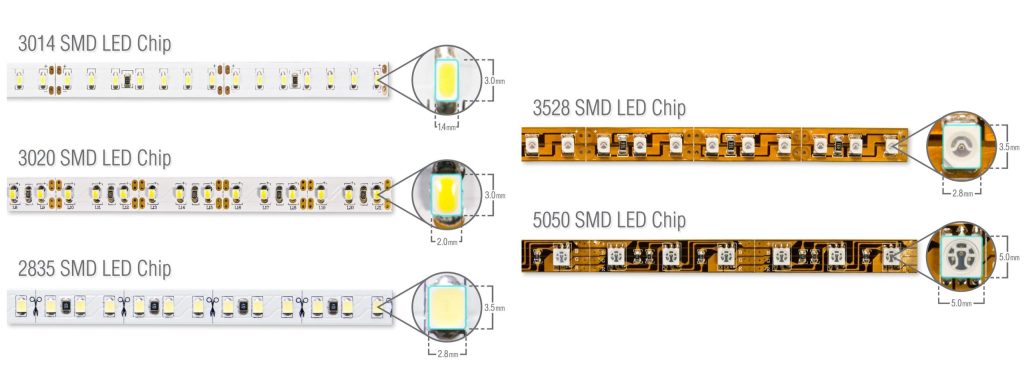
Secondly, the density or number of LEDs per meter directly impacts wattage. Strips with a higher LED count per meter consume more power but offer superior brightness and a smoother spread of light. Lower-density strips are less energy-demanding and provide a softer glow suited for accent lighting or diffused background illumination.
Color and brightness settings play an influential role in dictating wattage consumption. Running your strip lights at full brightness naturally demands more power than dimmed settings, while multicolor RGB configurations typically draw more energy compared to single-color options due to their simultaneous activation of multiple LED chips.
In sum, understanding these intricate factors influencing wattage enables users to strike an optimal balance between desired brightness levels and energy efficiency when selecting their perfect set of LED strip lights, be it for indoor decoration or radiant landscape lighting adventures.
Different Types of LED Strip Lights and Their Wattages
Exploring the Vivid Spectrum of LED Strip Lighting
LED strip lights, a popular choice for both indoor and outdoor illumination, come in a variety of types, each with its unique wattage requirements. The wattage essentially determines how much electricity the LED strip light will consume, making it a crucial factor in selecting suitable lighting for your specific needs. Understanding the different types of LED strip lights and their respective wattages can help optimize energy usage while achieving desired lighting effects.
Single-Color LED Strips
The Simplicity and Elegance of Single-Color LED Strips
Single-color LED strips are perhaps the most straightforward in terms of wattage calculation. These strips typically emit one fixed color, such as white, warm white, red, blue, or green. The single-color landscape strip lights are often used to create a mood or accentuate certain features within a space.
A typical single-color LED strip consumes about 4.8 watts per meter when it operates at full brightness. However, this can vary based on factors such as the density of the LEDs on the strip (number of LEDs per meter) and voltage input, among others.
The beauty of single-color landscape lighting lies in its simplicity; it offers an understated elegance that subtly enhances the aesthetic appeal without being overly flamboyant or distracting.
RGB (Red-Green-Blue) Color-Changing Strips
An Array of Colors at Your Disposal with RGB LED Strips
RGB LED strips add more versatility to your lighting options by allowing color mixing to achieve virtually any hue you desire. By adjusting individual intensities of red, green, and blue LEDs on these strips, you can create an entire spectrum of colors, including white. Generally speaking, RGB LED strip lights consume a higher wattage than single-color options due to the multiple LEDs working concurrently.
A standard RGB LED strip light tends to consume around 14.4 watts per meter when all three individual color LEDs are fully lit. RGB landscape strip lights are popular for their ability to dynamically transform an environment according to mood, event, or even time of day. The flexibility of manipulating colors provides endless possibilities for personalized lighting.
RGBW (Red-Green-Blue-White) Color-Changing Strips
Enhanced Color Accuracy with RGBW LED Strips
For an even wider range of color options and better white light quality, there’s the RGBW LED strip. These strips not only contain red, green, and blue LEDs but also feature dedicated white LEDs. This additional channel allows for richer, more accurate color mixing, including superior warm and cool whites. In terms of wattage, RGBW strips are typically the highest consuming among LED strips due to their additional white LEDs.
An average RGBW LED strip might consume anywhere from 18 to 24 watts per meter when all four sets of LEDs are turned on at full brightness. For landscape lighting that demands high-quality light rendering and a comprehensive spectrum of hues – from vibrant colors to nuanced shades of white – the RGBW landscape strip lights offer a compelling solution with unparalleled versatility.
Demystifying the Wattage of LED Strip Lights
Comprehending the power requirements of your LED strip lights begins with understanding how to read product specifications. These usually list the watts per meter or foot, giving you a clear indication of how much power is consumed by a particular length of light strip.
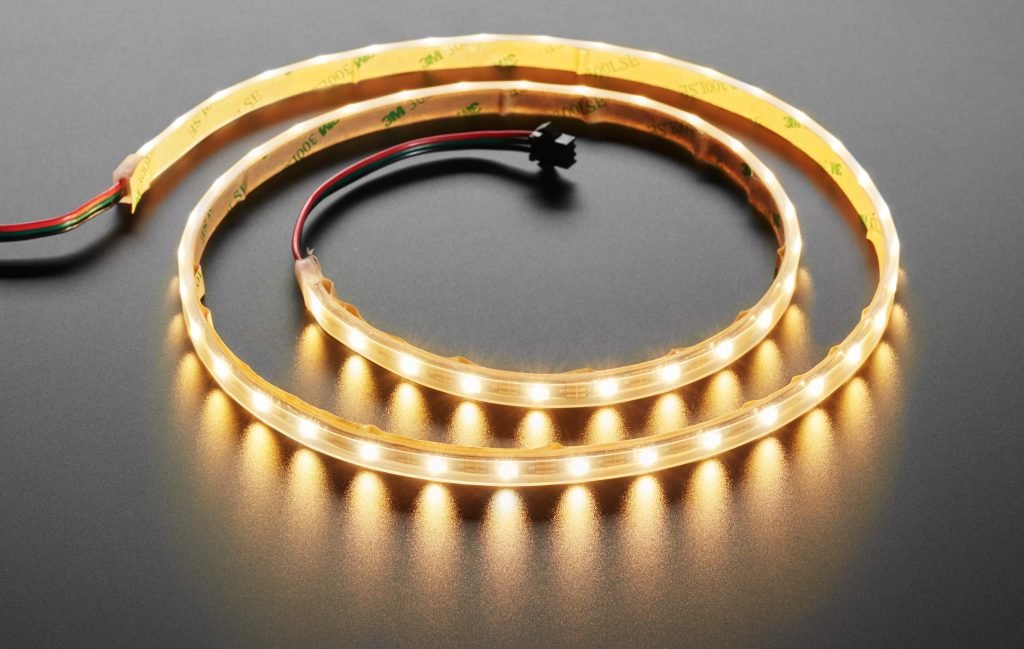
For instance, a rating of 14.4 W/m means that for every meter of the light strip, it will consume 14.4 watts. This detail is critical not only for your initial purchase but also for ongoing use. If you plan to connect multiple LED strips, you will need to multiply this wattage by the total length in meters or feet to get your overall power requirement. Unfamiliarity with these numbers can lead to inefficiencies or even damage from overloading.
To determine an LED strip light’s wattage using a multimeter, follow these steps: Connect the multimeter leads to the positive and negative ends of the LED strip and set it on DC voltage mode; measure and note down this voltage (V). Next, set your multimeter in DC amperage mode and measure current (I). The wattage (P) can then be calculated using Ohm’s law, P = VI.
The Power behind Your Project: Calculating Wattage Correctly
Ensuring an adequate power supply is crucial when installing an LED lighting system such as landscape lighting or landscape strip lights. When planning any project that includes LED strips, each string should be calculated individually depending on its length to avoid having underpowered lights, which could result in inconsistent brightness or complete failure.
Avoiding overheating and potential fire hazards is another significant aspect when dealing with electronic devices like LEDs. Overheating occurs when too much current passes through an electronic device; therefore, correctly calculating the wattage is essential to prevent these incidents.
Furthermore, maximizing the lifespan and performance of your LED strip lights starts with understanding their wattage. When the correct wattage is calculated and applied, it ensures that your lights will operate at optimal conditions, preventing premature burnout or unexpected failure.
In the Limelight: Case Studies of Wattage in Real-World Applications
Residential lighting projects often involve the use of LED strip lights for accent lighting in living rooms, kitchens, or outdoor landscaping. In these applications, lower wattage strips (such as 4.8 W/m or 6 W/m) are popular for their energy efficiency and sufficient brightness.
Commercial lighting projects, on the other hand, often demand higher light output. For instance, architectural installations or retail displays may utilize higher wattage strips (like 14.4 W/m or even 24 W/m) to achieve impressive brightness and color saturation.
Answering Your Queries about Wattage in LED Strip Lights
A common misconception concerning wattages in LEDs lies in equating higher wattages with brighter light output. While this is true for traditional incandescent bulbs, where more watts mean more brightness, LEDs don’t follow this rule strictly due to variations in efficiency among different types of LEDs.
Another topic frequently asked about relates to energy efficiency tips with LEDs. One important tip includes using a power supply with a slightly higher rating than your total calculated load, which allows some ‘breathing room’ for your power supply while extending its lifespan.
Conclusion: What Is the Wattage of LED Strip Lights?
The world of LED landscape lighting need not be intimidating nor complex if armed with essential knowledge like understanding the concept of wattage. Emphasizing attention to detail when calculating wattages can pave the way to a successful LED strip light installation, ensuring the longevity and brilliance of your lights, whether it be for indoor or outdoor applications. As we are on a continuous journey of learning and growth, there is always room for further consultation with professionals to ensure the most effective setup for our needs.
You may also be interested in the following posts: