
Fix the Glow: Understand Why String Lights Stop Working
The Radiant Riddle: The Enigmatic Life of String Lights
String lights, specks of brilliance that can turn the mundane into a spectacle, have consistently held their popularity in both functional and decorative avenues. From vibrant festivals to tranquil patios and from the sprawling landscape lighting of public parks to cozy indoor settings, these glowing strands add a magical touch.
They envelop spaces in their warm luminescence and breathe life into occasions by painting an enchanting canvas of light. The beauty and functionality of these lights have placed them prominently on the stage of outdoor décor as well.
Landscape string lights are a popular choice among homeowners who want to transform their backyards into surreal paradises. Whether it’s a chilly winter evening or a balmy summer night, string lights can create an inviting ambiance that beckons one towards the outdoors.
Despite their widespread use and appeal, string lights do carry with them an enigma: sometimes they suddenly cease working without any apparent reason. This is not only frustrating but also baffling, especially when the bulbs seem intact at first glance.
Demystifying Darkness: Why Understanding String Light Failure is Crucial
When landscape lighting fails to deliver its mesmerizing glow or when your Christmas tree stands forlornly without its regular twinkle, it leaves an absence that’s hard to ignore. Traditionally considered as mere adornments or festive essentials, the role string lights play has evolved significantly over time. They’ve become indispensable parts of our decor repertoire or essential fixtures for creating vibrant landscapes.
In this context, understanding why string lights stop working becomes more than just solving a small technical issue; it’s about maintaining aesthetic continuity and ensuring we can enjoy our spaces unhindered by erratic light failures. Besides this tactile aspect, gaining knowledge about why string lights cease to work is also a safety concern. Faulty lights can be potential fire hazards.
Occasionally, the problem might not be with the lights themselves but indicative of deeper electrical issues, making this understanding all the more crucial. Furthermore, knowing why string lights stop working can help us make informed choices when purchasing or maintaining these charming luminaries.
It encourages responsible usage practices and promotes a culture of repair over replacement – an attitude urgently required in our increasingly disposable society. Therefore, through this post we aim to embark on an enlightening journey, delving into the inner mysteries of string lights and extracting thought-provoking insights into how they operate and why they sometimes don’t.
Understanding the Basics of String Lights
Shining a Light: How String Lights Operate
String lights, an essential decor element in landscape lighting, operate on a simple principle that involves the flow of electricity through a circuit. When plugged into an electrical source, the current flows from this source through each bulb or diode in a string light sequence before returning to the power supply. This continuous circuit lights each bulb.
At their core, string lights are essentially miniature light bulbs attached to electrical wire. Each bulb contains two wires running into its base that connect to a filament or diode inside; these components constitute the heart of each bulb’s functionality. Electricity passes into one wire, heats the filament or diode until it glows, and then exits via the other wire.
The concept of electricity’s flow in string lights revolves around creating what is known as a series circuit. In such circuits, all components (in this case, light bulbs) are arranged sequentially so that there is only one path for electricity to follow. This means if one bulb fails in a series circuit – like many incandescent landscape string lights – it can interrupt electrical flow, causing every subsequent bulb to go out.
The Different Versions: Types of String Lights
There are two primary types of string lights most commonly used today: incandescent bulbs and light-emitting diodes. Each type offers distinct features and benefits suited for varied applications.
Incandescent String Lights: The Classic Glow
Incandescent string lights have been around for decades and provide a traditional warm glow often associated with festive occasions. They work by passing electric current through a thin tungsten filament situated within each bulb. As electricity passes through this filament, it heats up and begins glowing brightly – hence producing light.
However, incandescent bulbs are not very energy efficient, as most of the energy is lost as heat. Furthermore, their lifespan is comparatively shorter due to the continuous heating and cooling of the filament, which eventually causes it to break or burn out.
LED String Lights: The Modern Luminary
LED string lights are a more recent development in landscape lighting technology. Unlike conventional incandescents, LEDs don’t use a filament to generate light. Instead, they rely on semiconductors – when electricity passes through one of these semiconductors (a diode), it emits light.
LEDs are far more energy-efficient than their incandescent counterparts; they convert most power into light rather than heat. Moreover, LED bulbs can last up to 25 times longer than incandescent bulbs, making them an increasingly popular choice for decorative landscape string lights.
Common Reasons Why String Lights Stop Working: A Confluence of Factors
Burned-Out Bulbs: An Enlightening Story
The natural lifespan of bulbs, especially those used in landscape lighting, is a crucial factor that could cause your string lights to stop working. Everything has a finite shelf life, and light bulbs are no different.
Incandescent bulbs typically last around 1,000 hours, while their LED counterparts can shine brightly up to 25,000 or even 50,000 hours. The type of bulb you use in your landscape string lights will significantly influence their longevity. Therefore, opting for high-quality LED lights can ensure your garden remains aglow for extended periods. Despite the longer lifespan of LEDs, even these eventually dim and die out with time.
Interestingly enough, the failure of just one bulb can lead to a blackout in the entire chain. This is due to the series circuit system commonly adopted in most string lights – when one bulb goes out, it breaks the circuit and subsequently prevents electricity from reaching other bulbs down the line.
This principle demonstrates how integral each individual bulb is to maintaining the blanket of luminosity provided by your landscape string lights. Consequently, regularly checking and replacing burned-out bulbs could prevent an unexpected plunge into darkness.
Keep in mind that replacing burned-out incandescent bulbs with LEDs may not always work since they operate at different voltages; mixing them unintentionally might just darken your festive decorations sooner than expected.
Fuse Dilemmas: Avoiding a Short Circuit Circus
Fuses act as protectors or guardians if you will; their primary function is to prevent an overload on your landscape lighting system by melting or ‘blowing’ when there’s too much current passing through them. In a typical setup, string lights contain a small fuse in the plug.
If this fuse detects an unsafe surge of electricity, perhaps due to a power cut or lightning strike, it will blow to prevent damage to the circuit and the bulbs themselves. However, when such an event occurs, your entire string of lights will cease to function until you replace the blown fuse with a new one.
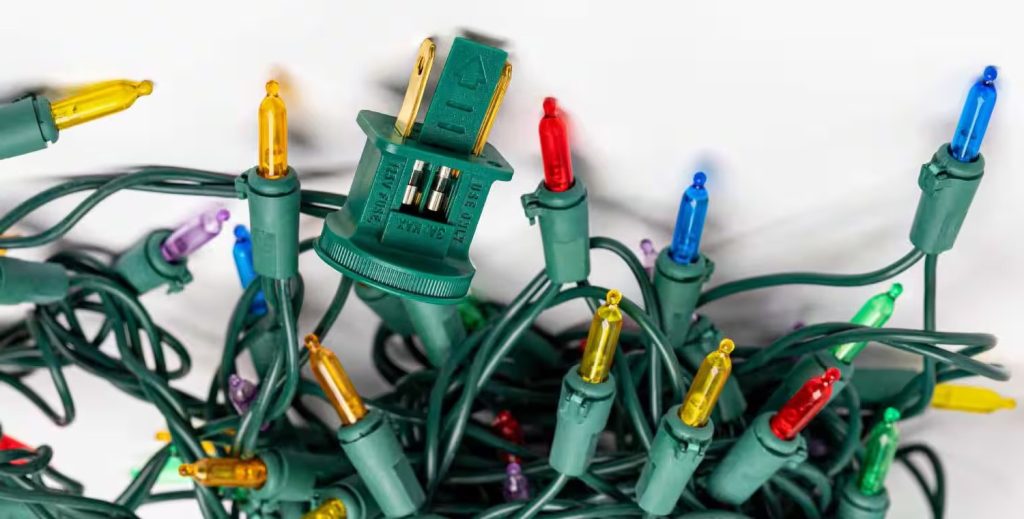
It’s an inconvenience for sure, but consider it as proof that the guardian is doing its job well. Knowing how to replace these fuses is crucial – not least because some people might mistakenly think their entire landscape string lights need replacing when all that’s required is a change of fuses!
The issue lies in the fact that fuses are often hidden away and thus often overlooked. However, once you locate them (usually in the plug), replacing them can be relatively straightforward and should restore your twinkling galaxy once again.
Electrical Wire Damage: The Unseen Saboteur
A common but often ignored reason why string lights stop working focuses on electrical wire damage. As landscape lighting is exposed to varying weather conditions – from torrential rainstorms to blistering heatwaves – there are multiple opportunities for wires to get damaged.
The encasing protecting wires from water can become compromised over time, or inadequate insulation may enable extreme temperatures to affect wire function directly – both leading scenarios causing your charming landscape string lights to flicker out.
Apart from volatile weather conditions, improper handling or storage can also cause wire damage. Twisting wires too tightly around a reel or tugging harshly during installation could break internal connections, leading up to unexpected dark spells in your light display.
Storing string lights improperly during off-seasons also commonly leads to wire degradation. If they’re bundled haphazardly into a box with other items pressing down on them, the likelihood of damage increases exponentially.
Moreover, rodents and pests can chew through wire insulation and cause disruptions in the electrical flow. Therefore, considering these aspects when installing and storing your string lights can significantly extend their lifetime.
Detailed Analysis: Rarely Known Reasons for String Light Failure
The Corrosive Effects of Moisture on Bulb Sockets
While landscape string lights are designed to withstand the great outdoors, repeated exposure to moisture can lead to corrosion in bulb sockets. This insidious process begins when condensation or water seeps into the socket, reacting with the metal components and gradually creating a thin layer of corrosion.
This tarnish impedes electrical conductivity and can cause the string lights to flicker or cease operation entirely. What’s more, this corrosion tends to be self-advancing: once it starts, it promotes further moisture accumulation, leading to more severe corrosion over time. In this way, even small amounts of moisture can eventually result in significant damage.
Interestingly, not all string lights are equally susceptible. LED landscape lighting systems tend to be better sealed against moisture intrusion compared with their incandescent counterparts and so are less prone to this problem.
To prevent this type of failure, choose waterproof or weather-resistant models whenever possible. It is also prudent to ensure that your landscape string lights are installed in a way that minimizes direct exposure to rain or sprinkler systems. A regular bulb replacement schedule will also help keep corrosion at bay since any old bulbs that have started corroding can be removed before they cause more widespread problems.
Voltage Irregularities leading to Premature Burnout
Voltage irregularities are another less-known reason for premature burnout in landscape string lights. These occur when there is an imbalance in the electric supply voltage and the voltage rating of the light bulbs being used.
The effect is analogous to forcing too much water through a narrow pipe; just as such a pipe may burst under pressure, so too might an over-volted bulb. This excessive electrical pressure can cause the filament or LED elements to overheat, reducing their lifespan and causing premature burnout.
Unfortunately, voltage irregularities can be difficult to diagnose since they often stem from issues with the broader electrical infrastructure. Yet they represent a significant threat: even minor fluctuations in voltage can dramatically shorten bulb life. To mitigate this risk, it’s advisable to use string lights with built-in voltage regulation features.
Alternatively, you can install a separate voltage regulator on your outdoor electrical circuit. These devices ensure that your landscape lighting receives a stable flow of electricity, thus preventing premature burnout due to sporadic surges.
Remember also that different types of bulbs have different voltage tolerances; LEDs are generally more tolerant of fluctuations than incandescent bulbs are. So switching to LED landscape string lights may provide another layer of protection against this issue.
Incompatibility Issues between Different Types and Brands of Bulbs
The last rarely acknowledged reason for string light failure concerns incompatibility issues between different types and brands of bulbs. While it might seem logical that any bulb with the right socket size will work in any string light system, this is not always the case.
Different brands and types of bulbs can have varying power requirements and heat dissipation characteristics – disparities that can lead to inconsistencies in brightness across an array or, worse still, cause some bulbs (or indeed the whole array) not to work at all.
This problem is particularly pronounced when mixing LED and incandescent bulbs on the same string. Their drastically different energy efficiencies often lead to insufficient power getting through for one or the other type of bulb to function correctly.
Moreover, even among same-type bulbs – say, LEDs, for instance – there could be incompatibility issues due mainly to design differences among manufacturers. Some LED bulbs may incorporate built-in resistors to minimize chances of burnout due to sudden voltage surges; others might not, leading to imbalances.
For all these reasons, it is generally best practice to use bulbs of the same type and from the same manufacturer in your landscape string lights. This will help ensure consistent performance and reduce the risk of premature failure.
Troubleshooting and Fixing Non-Working String Lights: Lighting the Path towards Solutions
The Lit Path: A Step-by-Step Guide to Identifying Common Problems
When your landscape lighting fails, the first step in troubleshooting is to identify if you’re dealing with a bulb or fuse issue. Start by methodically checking each bulb in your string of lights. Often, a single burned-out bulb can disrupt the entire series circuit, causing all bulbs to cease emitting light.
If you find a faulty bulb, swiftly replace it. If replacing bulbs doesn’t resolve the issue, proceed to inspect the fuses. Most string lights have a small fuse box within the plug. Its purpose is safeguarding your landscape string lights from potentially damaging electrical surges.
If upon inspection you find a discolored or cloudy fuse – that’s your culprit. Replacing fuses requires caution but can be done without professional help. Always ensure that you replace it with a fuse of identical rating to avoid further complications.
It’s important to note that individual bulbs and fuses can sometimes be challenging to inspect, particularly when dealing with larger sets of landscape string lights. Patience is key here; systematic investigation will lead you to the source of disruption. To reiterate – start simple: check for faulty bulbs followed by an inspection of fuses before moving onto more complex issues.
Shining a Light on Complexity: Advanced Troubleshooting Techniques
If basic troubleshooting doesn’t bear fruit, it might be time for advanced measures. Monitoring voltage irregularities can often identify hidden issues causing premature burnout in landscape lighting installations.
You’ll need a multimeter for this procedure – an instrument designed for measuring electric current (amperage), voltage, and resistance. By connecting this tool to your string lights, you can verify if the circuit is receiving proper voltage. An inconsistent or exceedingly high reading may indicate a problem with your power source, which could be causing your string light failure.
Next, check for corrosion in bulb sockets. Moisture intrusion among landscape string lights is a common occurrence and can lead to corrosion over time. This corrosion disrupts the electrical flow, causing bulbs to stop working.
Inspecting each bulb socket may seem tedious, but ignoring this step could leave you in the dark regarding the real issue. If you identify corroded sockets, clean them gently using a small brush and replace any affected bulbs.
Remember, advanced troubleshooting methods like these should only be undertaken if initial efforts prove futile. They require more time and precision but can uncover some of the more elusive causes of string light failures.
Lights and Safety: Precautions to Consider while Troubleshooting
Troubleshooting landscape lighting issues does not come without risks; it’s essential to prioritize safety throughout the process. Always disconnect your lights from their power source before beginning any inspection or repair efforts.
Using tools such as multimeters requires careful handling as well; improper use can result in electrical shocks or even fires. If you’re unsure how to use it correctly, consider seeking professional help.
When replacing fuses, ensure that you’re using fuses with identical ratings, as using an incorrect fuse type might lead to overheating or even fire hazards.
Avoid touching bulbs that have been on recently as they might still be hot and could cause burns – patience is crucial here too; give them time to cool off before initiating any repairs.
While restoring luminosity to your landscape string lights might sometimes feel like navigating through darkness itself, equipped with the right knowledge and necessary precautions, you can navigate your way through the most intricate issues.
Prevention: Keeping Your String Lights Glowing Longer
Meticulous Handling and Storage: Prolonging the Lifespan of Your String Lights
The longevity of your landscape string lights is largely contingent on how they are handled and stored. Much like any electrical device, they necessitate scrupulous care to safeguard their functionality. It is highly recommended to switch off and unplug your lights before any handling or adjustments are made, as this not only ensures safety but also prevents potential damage.
When removing landscape lighting after use, endeavor to begin at the end closest to the power source. This methodical approach aids in preventing any undue stress on the individual bulbs or connections that could potentially engender a circuit interruption.
Storage of string lights also demands careful consideration. When not illuminating your landscape, these lights should be kept in a cool, dry place where they are safe from environmental elements that could occasion corrosion or other forms of damage. A prudent practice involves wrapping the string around a piece of cardboard or a specialized light reel, ensuring each bulb has its own space, enhancing organization while minimizing risk of breakage.
The Indispensable Role of Appropriate Bulbs and Fuses
An often overlooked aspect in maintaining landscape string lights relates to using appropriate bulbs and fuses. Each variant of string lighting requires specific types of bulbs and fuses, which, if used interchangeably, can lead to premature failure.
Ensuring you utilize the correct bulb for your specific type of string light is absolutely crucial for continuous operation. Incompatible bulbs may draw excess current, leading to blown fuses or even compromising the entire lighting system’s integrity over time.
Fuses also play an integral role within this electrical system, acting as safeguards against current overload by blowing out when excessive current passes through them, thereby protecting other components from damage. Employing correct fuses enhances durability for longer enjoyment from your landscape lighting.
Conclusion: Why Do String Lights Stop Working?
Understanding why string lights stop working may seem like a vexing labyrinth at first glance. However, by grasping the underlying principles of these beautiful lighting systems, diagnosing potential malfunctions becomes less cumbersome and more akin to a stimulating puzzle.
By adhering to meticulous handling and storage procedures alongside using the correct bulbs and fuses, you can powerfully augment the lifespan of your landscape string lights. So, let’s light up our landscapes with confidence and bask in their delightful glow, knowing we have done our part in helping them shine for as long as possible.
You may also be interested in the following posts: