
An Easy Guide to Hanging Outdoor String Lights on Decks
A Luminous Addition: The Value of Outdoor String Lights
Outdoor string lights can transform any ordinary deck into an enchanting oasis. They bring a hint of magic, a splash of color, and a shower of light, creating an ambiance like no other. Their twinkling glow can turn everyday evenings into special soirees. String lights are not just visually delightful but also offer practical benefits.
They provide additional lighting for your outdoor activities like barbecues or late-night parties. Their warm radiance creates a cozy atmosphere that makes your outdoor spaces more inviting. From the perspective of safety, well-lit exteriors can deter potential trespassers and illuminate potential trip hazards. It is here that landscape lighting comes into play in adding both allure and safety to your property.
Landscape string lights strung around your deck railing or under the deck could be the perfect solution for this dual-purpose need. Moreover, having appropriately placed lighting around your deck helps you extend indoor comforts to the outdoors without compromising on visibility during low-light conditions.
String Lights: Decking Up Your Deck
Deck string lights are infinitely versatile and can significantly enhance the visual appeal of your home’s exterior space. While their application is often underestimated by homeowners, they indeed possess tremendous transformative power beyond mere decoration – granting even the most basic decks an enchanting fairy-tale likeness.
Imagine enjoying a quiet evening with loved ones under a sky glimmering with stars reflected by an equally stunning display from your under-deck landscape lighting – what could be more beautiful? Or think about hosting summer barbecues made memorable with laughter shared under warm strings of delicate light wrapped around your deck railings – truly magical moments were made possible by this simple yet effective addition.

Our focus here will dwell primarily on helping you harness this potent aesthetic force: hanging outdoor string lights on decks to enliven every moment spent there. This post aims to enlighten your understanding, inspire your imagination, and offer practical guidance on every step of this process. We will explore different types of outdoor string lights suitable for various styles, practical tips for ensuring a well-lit and safe outdoor space, as well as creative ideas to further enrich the charm brought about by these lights.
Welcome aboard on this enlightening journey towards decking up your deck with the captivating allure of outdoor string lights. Let’s light up your world!
Understanding Outdoor String Lights
Outdoor string lights, also known as landscape string lights, provide delightful lighting for your deck and surrounding spaces, creating an ambient setting where friends and family can gather for leisurely evenings. They cast a warm glow over your outdoor area while also offering added safety by illuminating dark corners.
There is a panoply of outdoor string light types available on the market; the three primary types are fairy lights, globe lights, and festoon lights. Each has its unique characteristics and charm that can enhance the aesthetics of your deck.
A Close Look at Different Types of String Lights
Fairy Lights: Delicate Lighting
Fairy lights are small-sized LED bulbs attached to a thin wire. They emit soft twinkling light that looks like tiny stars suspended in mid-air. Wrap them around your deck railing or weave them into garlands for a whimsical touch. Given their delicate structure and subtle lighting effect, fairy lights are perfect for highlighting specific areas under the deck or creating intricate lighting details around outdoor furnishings. Their versatility allows you to get creative with your landscape lighting design.
Globe Lights: Bright and Bold
Globe lights consist of larger bulb sizes compared to fairy lights. As their name suggests, these feature round bulbs that emit bright light covering wider areas around the deck. They are an excellent option if you’re looking to make a bold statement with your outdoor lighting. Their robust design makes them suitable not just for decking but also for open yard spaces where more lighting is needed. Whether they’re strung across trees or hung along fences, globe lights create an inviting atmosphere reminiscent of vintage-style street lamps.
Festoon Lights: The Classic Choice
Festoon lights, with their elongated Edison-style bulbs, exude a feel of timeless charm. They produce warm, soft light that is appealing and relaxing. Festoon lights are perfect for creating a classic vintage look around your deck. Whether strung across above the deck space or draped along the under-deck area, festoon lights offer an enduring aesthetic appeal that enhances any outdoor setting.
Factors to Consider when Choosing Outdoor String Lights
Weather Resistance: Braving the Elements
Given their placement in an outdoor setup, landscape string lights need to be weather-resistant. They should be able to withstand elements like rain, snow, and intense sunlight without compromising their functionality or lifespan. The ingress protection (IP) rating on string lighting packages indicates its level of waterproofing and dust resistance. Ensure you opt for string lights with a high IP rating designed for outdoor use to guarantee durability despite changing weather conditions.
Bulb Type: LED vs Incandescent
The type of bulb used in your string lights greatly influences the quality of light they emit and their energy consumption level. LED bulbs are energy-efficient and have a long lifespan compared to traditional incandescent bulbs. In addition, LED bulbs are more durable and remain cool to touch even after hours of operation, which is beneficial around decks where children might run into them. Despite these advantages, though, some people still prefer the warmth of incandescent bulbs, which can give off a more nostalgic glow.
Power Source: Plug-In, Battery, or Solar?
Your choice regarding the power source for your landscape lighting depends largely on its intended location and the availability of power outlets around your deck space. Plug-in string lights provide consistent lighting but require access to an outdoor electrical outlet or extension cord. They are a practical choice for decks with easy access to a power supply.
On the other hand, battery-operated lights offer more flexibility in placement as they don’t need to be near an outlet. Solar-powered options convert sunlight into electricity, storing it for use after dusk. This eco-friendly alternative is best suited for areas that receive ample sunlight throughout the day.
Brightening Your Space: Planning Your Lighting Design
Planning your lighting design is an integral step in the process of hanging outdoor string lights on your deck. It requires a blend of creativity and an understanding of the existing architecture and landscape. Before diving into the specifics, it’s crucial to envision how you want your deck to look after the lights have been installed.
This vision will guide each decision you make moving forward. Measurement plays a significant role in planning your lighting design as well. It’s necessary to measure your deck accurately to ensure you purchase enough string lights for full coverage without any gaps or overly dense areas.
Fashioning with Light: Determining the Design Style
Determining your design style is essentially choosing how you want your landscape string lights to be arranged on the deck. There are various styles that one can choose from, but here we’ll cover three main ones: random scatter, zigzag pattern, and border outline.
Random Scatter
The random scatter style is akin to stars scattered across a night sky – there’s no specific pattern, yet they form a beautiful spectacle when viewed as a whole. The key lies in their randomness; by hanging landscape string lights in a non-linear manner around the deck and even under the deck if available space allows, this style evokes an enchantingly whimsical aura.

Zigzag Pattern
The zigzag pattern offers more structure compared to random scatter. To achieve this look, start at one corner of the deck railing and hang your string lights diagonally across to another point on the opposite side. Then reverse direction and continue this zig-zag arrangement until all areas are covered. This pattern provides ample lighting while also adding visual interest due to its geometric structure.
Border Outline
The border outline method involves tracing along architectural lines, such as around deck railings or under the deck roof line. This style accentuates the structure of your deck, highlighting its unique features. It’s a more traditional method but can evoke an elegant and streamlined look that’s pleasing to the eye.
Measured Lighting: Accurate Light Count and Placement
Successfully executing your chosen design style relies heavily on accurate measurement of your space. This step is not merely about ensuring you have enough string lights; it’s also about arranging them optimally for both aesthetic appeal and practical lighting.
First, measure the length around your deck or along the paths where you plan to hang your lights. Ensure to account for any extra length needed for curving around corners or going up and down deck railings.
Next, consider how densely you want to arrange your lights. If you’re going for a star-studded effect with a random scatter design, you might want more lights closer together.
On the other hand, if you’re opting for a cleaner look with a border outline or zigzag pattern, evenly spaced landscape lighting could be more favorable. Once measurements are done accurately and carefully, it will save time during installation and create an effective lighting ambiance that graces every corner of your deck with warmth.
Preparing the Deck for Installation: The Prerequisite for Perfect Landscape Lighting
Complying with Local Regulations: A Crucial First Step
Before embarking on your project to install landscape string lights around your deck, one important step is to check local regulations about outdoor lighting if they exist. These regulations may govern the type of lights you can use, their power consumption, or even how bright they are allowed to be. In some cases, there might be restrictions on hanging fixtures that could potentially pose a safety hazard.
In addition to municipal regulations, your Homeowner Association or building management company may also have rules regarding outdoor décor and lighting. Being cognizant and respectful of these guidelines will not only ensure compliance but also foster goodwill among neighbors and authorities.
Checking these rules is essential because noncompliance could lead to penalties or required removal of the installed lights. Understanding these restrictions ahead of time allows you to choose appropriate landscape string lights and avoid any unwelcome surprises down the line.
Assessing the Deck Structure: Finding Secure Attachment Points
Once you obtain clearance from relevant authorities, it’s time to assess your deck structure for suitable attachment points for hanging the landscape string lights. Start by examining potential anchor points around your deck, such as posts, railings, trellises, or even nearby trees.
You’ll need strong anchor points that can handle the weight and tension of the strings over time without causing damage. Under-deck structures often provide a wealth of attachment points as well, which may lend more creative design opportunities.
Next up is calculating where each light strand will begin and end based on their length compared to the distance between attachment points. Keep in mind that landscape string lights should hang with a slight slack ‘swag’ rather than pulled tight between anchor points.
But importantly, it is taking into account potential obstacles or hazards like doors, windows, or areas of high traffic. You wouldn’t want your beautiful landscape lighting to become a tripping hazard or obstruct regular deck activities.
Gathering Necessary Tools and Safety Equipment: Ensuring Seamless Installation
Having the right tools in hand before starting with the installation process is indispensable. Some of the basic tools needed include a measuring tape to calculate the distance between attachment points, a drill and screwdriver to install hooks or clips to your deck railing, and possibly an extension ladder for reaching higher places.
Additionally, you might need wire cutters if you’re working with plug-in lights that require custom lengths and some electrical tape for safely sealing any connections. A light bulb changer could also come in handy, especially for higher-hanging lights.
Safety equipment is another important consideration. Depending on how involved your installation will be, this could include gloves to protect against potential cuts or abrasions from handling light strands and safety glasses when drilling into structures.
But importantly, if you will be using a ladder during installation, ensure it is sturdy and have someone around for assistance if possible. Deck surfaces can sometimes be uneven, so take special care when setting up your ladder around deck structures.
Step-by-Step Guide to Hanging Outdoor String Lights on Decks
Securing Your Landscape with Hooks or Clips
Creating an enchanting atmosphere begins with setting up the structure for your landscape string lights. The first step is attaching hooks or clips to your deck structure. Find strategic points around your deck that would provide a good foundation for hanging the lights. Common places include posts, railings, and even under-deck structures for a more diffused lighting effect.
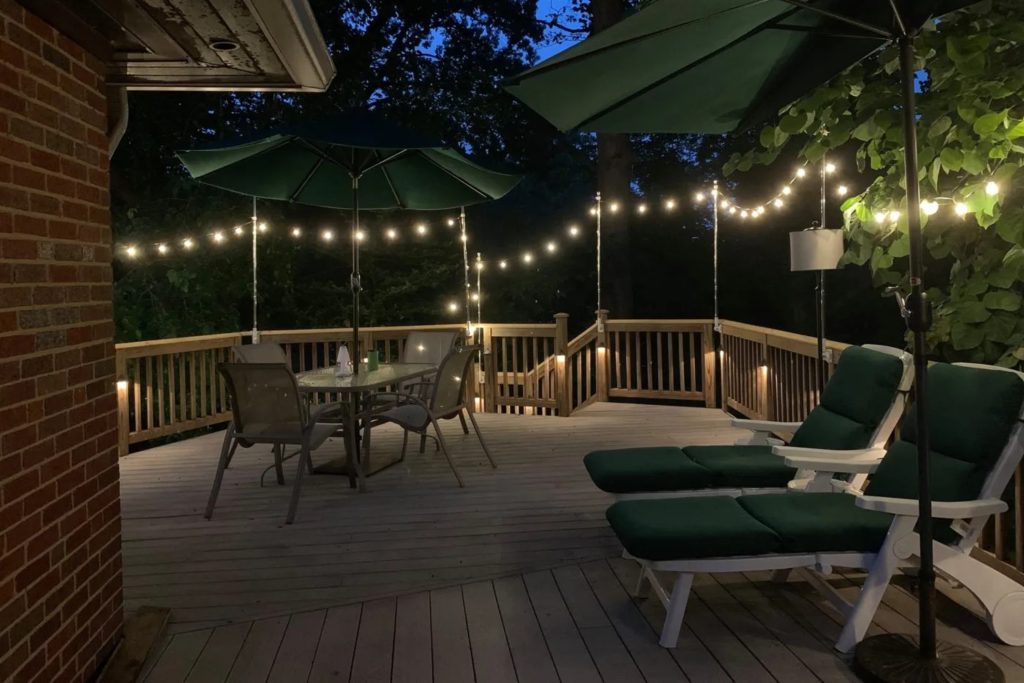
One must consider the material of both the clips or hooks and the deck itself before proceeding. Metal hooks are preferable due to their longevity and robustness but may not work well with composite decks. Plastic clips are also an option, as they can withstand various weather conditions while causing minimal damage to your deck structure.
Alignment is crucial when you want to create a spectacular display of landscape lighting. Ensure that you evenly space out these attachment points for a balanced look. A measuring tape will be helpful in maintaining consistency throughout this process.
The choice between screws and adhesive largely depends on personal preference as well as how temporary or permanent one wants the setup to be. Screwing requires more effort, but it provides sturdier support, while adhesive allows flexibility but might not hold up against strong winds or heavy bulb types.
The Art of Draping: Hanging Your String Lights
Once you’ve securely fastened your hooks or clips, proceed with hanging your string lights carefully around the deck without pulling them too tight or leaving them too loose. Start by unfurling your string light bundle – be careful not to pull it apart forcefully, as that could potentially damage the wiring inside.
Decide on which part of your deck will serve as a starting point, then delicately hang one end of the string light onto one of your pre-attached hooks or clips; continue by looping it around subsequent hooks until you reach its endpoint within its range. Take care to ensure that the string lights are neither too taut nor too slack.
A slight swag gives an appealing visual effect while preventing undue strain on either end of the landscape lighting. Repeat this process for all string light strands, remembering to maintain consistency in terms of style and pattern.
While draping your landscape string lights around deck railings, be mindful of any necessary adjustments due to varying heights or obstacles. Flexibility is crucial at this stage – don’t be afraid to reattach hooks or clips if it means achieving a better result.
Powering Your Landscape: Safe Electrical Connections
The final stage involves safely connecting your newly draped outdoor string lights to a power source and ensuring that they all function as intended. The power source depends on the type of lights you’re using – some might require an outdoor-rated extension cord for connection to an external power outlet, while others might have solar panels or batteries.
Ensure that you connect your landscape lighting safely by employing protective features like weather-resistant receptacles, gasket-covered outlets, or even a residual current device (RCD) for enhanced safety measures against electrical faults.
Once you’ve connected your string lights to their respective power sources, it’s time for the moment of truth – switch them on! Marvel at the warm glow that now illuminates your deck, but don’t forget to check each bulb for any signs of malfunctioning.
Sometimes shipping damage or manufacturer fault can result in a few bulbs not lighting up properly; hence, it’s always wise to have replacements ready beforehand. After addressing any faulty bulbs and making necessary replacements, step back and admire the beautiful transformation you’ve accomplished with these twinkling stars around your deck.
Incorporating outdoor string lights into your deck setup can enhance its overall aesthetic appeal significantly. By meticulously attaching hooks or clips onto sturdy points around your deck railing or under-deck spaces, artfully hanging each strand of landscape string lights, and responsibly connecting them to safe power sources, you can create a magical ambiance that conjures up enchanting summer nights under the stars right in your backyard.
Maintenance Tips for Outdoor String Lights on Decks
The Art of Cleaning Landscape String Lights
Regular maintenance of your outdoor string lights is essential to ensure their longevity, and cleaning forms a crucial part of this process. Depending on your geographical location and the amount of dust or grime they accumulate, it’s prudent to clean your string lights at least twice a year. However, in areas prone to high pollution or airborne particles, monthly cleaning might be advised.
Interestingly, cleaning landscape string lights isn’t as formidable a task as it might seem. A gentle wipe with a soft rag damped with mild dish soap and warm water typically suffices. Remember never to immerse the bulbs in water lest you risk damaging the electrical components. The bulb sockets should also be given attention; they can be carefully cleaned using canned air or a small brush.
While conducting this operation, take into account that some lights may have specific cleaning requirements that mustn’t be flouted. Always refer back to the manufacturer’s instructions before embarking on any cleaning procedure.
Also consider unplugging your lights before starting the cleaning process for safety reasons. Moreover, landscape string lights adorning your deck railing might welcome bird droppings or insect residues due to their outdoor location; ample care must be taken while dealing with such situations.
Using natural enzyme cleaners can help break down organic matter without causing harm to your lighting fixture or the environment. Take note that keeping your under-deck area clean can prevent dirt from rising and accumulating around deck light fixtures when wind gusts sweep through.
Replacing Bulbs: When and How?
Identifying when bulb replacement is necessary forms another vital aspect of maintaining your outdoor string lights properly. A dimming bulb, incessant flickering despite no voltage issues, or an outright burnout are common indicators suggesting that a replacement is due.
To replace dead bulbs safely, start by turning off and unplugging the string lights. Allow them to cool down if they were in use recently. Carefully twist the faulty bulb counterclockwise until it comes free from the socket. When inserting the new bulb, align it with the socket threads and gently turn it clockwise till it’s secure.

It’s advantageous to keep a set of replacement bulbs handy to avoid unnecessary hassles when one burns out. Ensure that these replacements match the specifications of your original bulbs in terms of voltage, wattage, and size to maintain consistency in lighting ambiance.
Moreover, consider upgrading from incandescent bulbs to LED ones if you haven’t already done so. LEDs consume lesser energy and often have a longer lifespan which means fewer replacements in the long run.
On another note, deck railing adorned with string lights may require special care while replacing bulbs due to their elevation from ground level. Use a stable ladder or platform for optimal safety during such operations.
Seasonal Care: Weathering through Varying Conditions
Depending on your region’s climate changes throughout a calendar year, different weather conditions may demand specific attention towards your outdoor string lights maintenance routine. During winter months where snowfall is prevalent, consider removing your landscape string lights or at least ensure they are rated for such temperatures and moisture levels before leaving them out in the cold.
Snow accumulating on your under-deck area can potentially damage fixtures as it melts and drips onto them. As spring approaches with increased rainfall activity, verify that all connections between strings are tightly sealed against potential water ingress, which can lead to short circuits or rusting sockets over time.
Summer months bring higher temperatures and greater sunlight exposure, which can degrade certain materials faster unless they are UV resistant. Regular inspections during this period will help identify any premature wear signs requiring attention.
Autumn leaves falling on deck railings embellished with string lights add aesthetic beauty but also necessitate regular clean-up to prevent potential fire hazards or blockages in light dispersion. Varied seasons bring unique challenges and considerations for maintaining outdoor string lights, but with mindful practices, you can keep your lights shining brightly all year round.
Creative Ideas for Using Outdoor String Lights
Transform Your Deck into a Magical Space
Nothing quite compares to the ethereal glow emitted by outdoor string lights strewn haphazardly around the deck. It transforms your outdoor space into a magical setting, perfect for those late-night soirees or simply enjoying some solitude under the stars. The gently twinkling illumination cast by the string lights can add an enchanting ambiance to your alfresco dinner parties.
Decorate Your Landscape with String Lights
Harnessing the potential of landscape string lights can truly revamp your entire yard. String them along pathways or drape them over lush shrubs to create a whimsical garden landscape that’s sure to impress any guest. Position them strategically for effective landscape lighting, and you have an inviting glow guiding you around your property all year round.
Lights Beneath: The Under-Deck Concept
An often overlooked but highly effective place to hang string lights is right under your deck. This not only lends an illuminated glow emanating from beneath but also serves as practical lighting needed in otherwise dim areas of your yard or garden.
Highlight Architectural Features
Utilize outdoor string lights to highlight specific architectural features of your home or landscaping elements like an arbor, gazebo, or trellis. Strung along deck railing, they create a beautiful pattern, enhancing visibility and safety while also providing a charming aesthetic effect.
The Festive Feel: Evergreen Use of Lights
Don’t limit yourself to only using these lights during certain times of the year! They are perfect for creating that festive feel all year long – be it during balmy summer nights when you want to dine alfresco or during festive seasons when you want that added sparkle around your home.
Conclusion: How to Hang Outdoor String Lights on Decks?
The art of hanging outdoor string lights on decks is not merely a task to be accomplished but a creative endeavor that opens up myriad possibilities for your exterior spaces. With careful planning and implementation, you can transform your deck into a luminous wonderland, enhancing its architectural features while infusing an air of enchantment into your surroundings.
Whether it’s arranging lights in intricate patterns along the deck railing or creating dreamy landscape lighting using string lights, every corner of your outdoor space holds potential. So go ahead and turn your deck into an inviting oasis for everyone to enjoy under the soft glow of charming string lights.
You may also be interested in the following posts: